In Kenya, planned power interruptions are published as formal notices listing affected markets, schools, and villages by name, and customers are directed to the website, social media, or the newspaper to find them. The gap is real enough that independent apps exist purely to convert those notices into phone alerts. The utility holds the meter records and the phone numbers. Someone else does the notifying.
A utility outage notification system is the set of workflows that tells each affected customer about a planned or unplanned interruption on a channel they actually use, confirms restoration when service returns, and captures inbound outage reports, all tied to meter and account records rather than blasted to an entire contact list. Most utilities in Africa and Southeast Asia already send messages. Very few run a system in this sense, and the difference shows up in call center volume, revenue collection, and public trust.
This post is written for the person who owns that difference: the commercial services or customer service manager at a distribution utility, a water service provider, or an electric cooperative. You are not being sold on whether SMS works. You already send thousands of messages a month. The problem is what those messages are connected to.
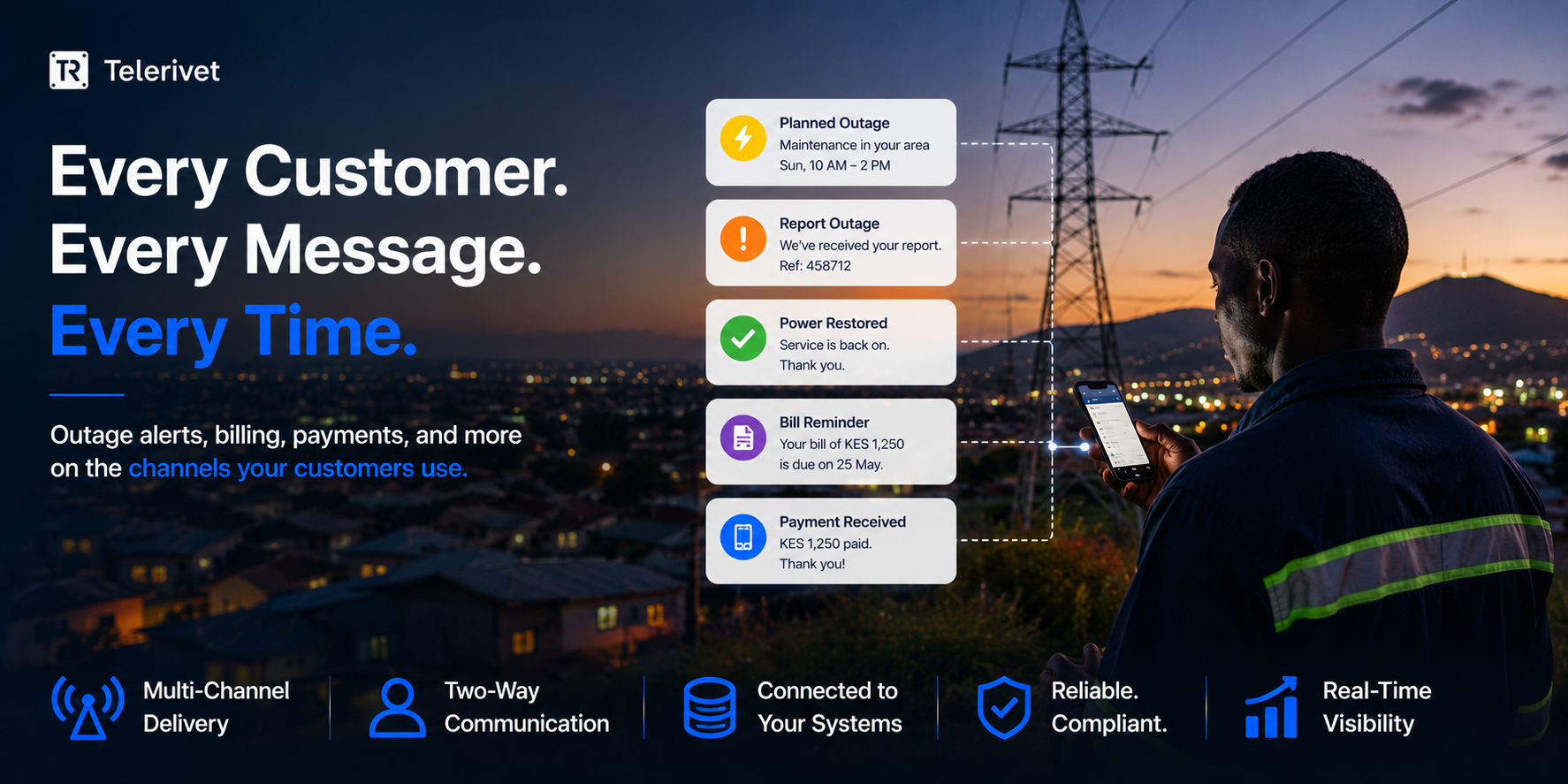
Five messages that never meet
Walk through the life of a single account and count the communication events. A planned interruption notice before maintenance. An inbound report when the power goes out unexpectedly. A restoration confirmation when it comes back. A bill, or a low-balance warning on a prepaid meter. A payment confirmation, and behind it the disconnection notice and the reconnection confirmation that bracket every collections cycle.
At most utilities these five messages are produced by five disconnected activities. The maintenance department drafts the interruption notice. The call center logs outage reports. Billing runs its own batch messages from the billing system. Payments confirmations, if they exist, come from the payment provider rather than the utility. Nobody sends restoration confirmations at all, which is why customers call the moment the power returns to ask whether it will stay on.
The interesting thing is that inbound reporting already works culturally. Kenyan customers report outages by texting their meter number in a structured format and receive a reference number back. Water utilities in Nairobi built dedicated complaint channels a decade ago. The habit exists. What is missing is the connective logic: the outage report that automatically updates every other customer on the same transformer, the restoration message that closes the loop with everyone who reported, the payment that immediately cancels a pending disconnection notice. That connective logic is what communication orchestration refers to, and utilities are one of the clearest cases for it, because the account data that should drive the routing already exists in the meter database.
Delivery is the hard part, not sending
A notification system that reaches 70 percent of affected customers is not a system, it is a lottery. Utility customer bases in Kenya, Ghana, Tanzania, or the Philippines span smartphone users on WhatsApp, feature phone users reachable only by SMS or voice, and rural accounts where network coverage itself is intermittent. Any single-channel design fails a predictable segment of the grid.
The evidence for channel diversity is not theoretical. When Nairobi's water complaint platform launched, its designers discovered that many users preferred calling over texting to report service problems, and the platform had to add voice to work. A notification strategy for a distribution utility needs the same honesty: SMS as the reliable floor, USSD for balance checks and self-service on any handset, voice or IVR for customers who will not read a message, and WhatsApp or Viber where smartphone penetration supports it. The channel question deserves an explicit decision rather than a default, and we maintain a practical guide to choosing between messaging channels for exactly that decision.
Then there is the failure case. Messages fail silently, and for a disconnection notice or a safety alert, silence is a liability. A well-built workflow retries on a second channel when the first fails, and for the messages that matter most, asks for a reply, because delivered is not the same as received.
The payoff is measurable. A smart metering pilot in Kigali paired meter data with SMS notifications and recorded a 41 percent drop in billing complaints, with over a third of customers adjusting usage in response to the messages, contributing to a 23 percent reduction in non-revenue water. Communication was not a customer service garnish in that project. It was a revenue protection tool.
The payment side is a communication problem too
Most utility revenue in these markets now moves through mobile money, and mobile money creates a specific failure mode: the customer has a payment receipt on their phone, and the utility's system has not updated. On a postpaid account that produces an angry call. On a prepaid meter it produces a family in the dark holding proof of payment, which is the fastest way a utility loses public trust.
The fix is a workflow, not a portal. Inbound payment notifications can be parsed automatically, matched to the account, confirmed back to the customer within seconds, and used to trigger the next action, whether that is a token delivery, a reconnection order, or cancellation of a pending disconnection notice. We have written about the general version of this problem in what should happen when a payment arrives but the account does not update, and utilities are its highest-stakes instance, because the product being cut off is light and water.
Prepaid vending sharpens the point further. A token that arrives five minutes late is a support ticket. A token that never arrives is a customer standing at a kiosk at night. Token delivery over SMS with automatic retry and a self-service resend keyword turns the single most common prepaid complaint into a workflow that resolves itself.
The same pattern, under typhoon conditions
Shift the scene to the Philippines and the pattern holds with higher stakes. More than a hundred electric cooperatives distribute power across the archipelago, and their outage communication is stress-tested by typhoon season rather than scheduled maintenance. A cooperative that can notify affected barangays before a planned interruption, receive structured outage reports as a storm passes, and confirm restoration feeder by feeder is doing emergency communication and customer service with the same workflows. The channel mix simply shifts: Viber and SMS dominate, and payment confirmations run through GCash and Maya rather than M-PESA. Distribution utilities in South Asia and municipal water providers in Latin America face the same architecture question with their own channel and payment variations.
The overlap with disaster response is not incidental. The workflow that notifies a feeder about maintenance is structurally the same one that powers early warning and dispatch systems, which is why utilities that build it well end up with a public safety capability they did not set out to buy.
What this looks like in practice
On Telerivet, the pieces of this system are standard building blocks rather than custom development. Contact groups mapped to feeders, transformers, or billing zones make targeted interruption notices a five-minute task instead of a gazette publication. Automated services handle inbound meter-number reports and reply with a reference. Keyword self-service lets a customer text BALANCE or RESEND and get an answer from their own account data. Payment confirmation workflows parse mobile money receipts and trigger whatever comes next. Routes and failover logic decide, per message, how to reach each customer and what to do when the first attempt fails.
None of this requires replacing the billing system or the meter data platform. It requires connecting them to the messages they should already be driving.
Frequently asked questions
What is the best channel for utility outage notifications? There is no single best channel. SMS reaches every handset and is the reliable floor. USSD supports balance checks and self-service without a smartphone. Voice reaches customers who will not read a message. WhatsApp and Viber add rich formats where smartphone use is high. The strongest systems assign a channel per customer and fail over automatically when a message does not go through.
Can a utility send targeted outage alerts without a smart grid? Yes. Targeting requires mapping customer records to feeders, transformers, or zones, which most billing databases already contain. Smart meters improve detection of outages, but notification only needs accurate grouping and a phone number.
How do prepaid utilities confirm mobile money payments automatically? Inbound payment notifications from providers like M-PESA, GCash, or Maya can be parsed by an automated workflow, matched to the customer account, and confirmed back to the customer by message, with the token delivery or reconnection triggered in the same flow.
Ready to see what this looks like on your grid? Talk to Telerivet about building outage, billing, and payment confirmation workflows that reach every meter you serve.
