When a mobile money payment arrives for a PAYGo solar account, a loan repayment, or a utility service, the payment itself is only half the workflow. The other half is the inbound confirmation: the system that detects the payment, parses the transaction details, matches it to the correct account, and triggers the downstream action, enabling the device, updating the balance, sending a customer confirmation. Most operators build the outbound half carefully and underinvest in the inbound half. That is usually when they discover what the inbound half costs when it fails.
The part of PAYGo communication that gets designed carefully is usually outbound: the sequence of payment reminders that goes out when an account approaches its due date, the disconnection warning, the re-engagement message after a lapse. That's the visible half of the loop..
The less visible half is inbound. When a customer pays through mobile money, the carrier sends a text message to confirm the transaction. That message lands on the PAYGo operator's receiving number. A parser reads the message, extracts the transaction ID, the amount, the sender's number, and the timestamp, then fires a webhook to the payment platform. The customer's account gets updated. Their solar unit stays on, or their cookstove token gets extended.
If the parser fails, none of that happens. The customer paid. The account doesn't update. And the first signal the operations team gets is a support call from a customer who can't understand why their device is still locked.
This is the inbound payment confirmation workflow. It's the one that tends to break in ways that are both invisible and immediately consequential.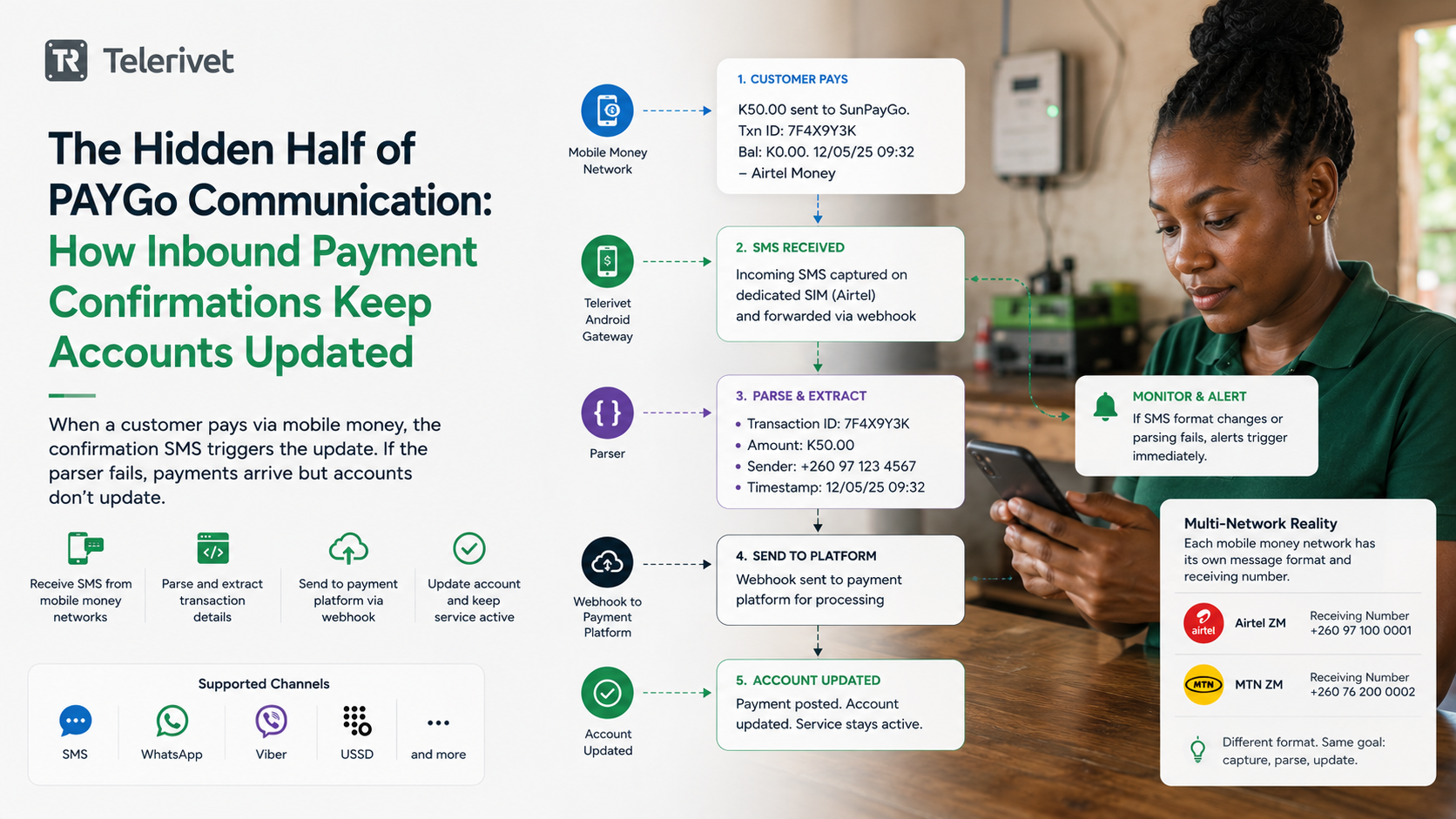
Why It Breaks
Mobile money confirmation messages are formatted by the carrier, not by the operator. The structure of a transaction confirmation SMS from Airtel looks different from MTN's. It may look different in Zambia than it does in Uganda. And crucially, it can change at any time when a carrier updates its system, adds a field, reorders the message structure, or reformats for a new product line.
A clean cooking company in Zambia running PAYGo financing across two mobile money networks experienced this firsthand. Their payment processing had been running reliably for months. One morning it stopped working. The cause wasn't a system outage or a failed API call. Airtel had changed the format of their mobile money confirmation SMS. The parser was looking for transaction fields in positions that no longer existed. Payments were arriving. The system wasn't reading them correctly.
The fix required identifying the new format, updating the parsing logic, and redeploying. The gap between the carrier's format change and the operator's fix is the window where payments arrive but accounts don't update - where customer trust erodes and support queues fill up. In a product category where customers are often first-time fintech users in low-income households, that kind of unexplained failure is hard to recover from.
What the Receiving End Looks Like
The payment confirmation SMS is a text message delivered to a phone number the PAYGo operator controls. In markets where the operator covers two or three networks simultaneously, that means maintaining a separate receiving number per network, because each carrier sends its confirmation message to the number registered for that network.
Telerivet's Android Gateway handles this receiving function. A dedicated Android device with a SIM registered to each relevant network runs continuously, captures every incoming SMS, and forwards it via webhook to the payment platform. The phone is treated as a fixed, always-on receiver: plugged into power, connected to the network, not used for anything else.
The advantage of this approach over a cloud SMS endpoint is coverage fidelity. Cloud SMS routes are aggregated - traffic can be filtered, delayed, or silently dropped depending on the carrier. An Android SIM on the Airtel network receives exactly what an Airtel SIM receives, including system-generated confirmation messages that carriers sometimes route in ways that bypass cloud aggregators.
Multi-Network Reality
An operator running across Airtel and MTN is running two parallel inbound workflows. Each has its own Android device, its own receiving number, its own webhook configuration, and its own parsing logic, because the message formats differ between carriers.
Monitoring matters here too. A format change from Airtel doesn't affect the MTN flow, but it may not be immediately obvious which network's confirmations have stopped processing unless there's alerting at the parsing layer. The cleanest version of this setup treats any incoming SMS that doesn't match a known format as an alert condition, not a silent pass-through.
This is the part that's easy to underestimate when the system is first being built. A PAYGo operator who spends significant engineering time on the outbound reminder sequence and then treats the inbound confirmation as a simple webhook will eventually discover that the simpler-seeming half of the loop is where the real operational dependencies sit.
The Pattern Across Other Verticals
The same logic applies wherever a payment confirmation travels via carrier-generated SMS. Mobile money operators in East Africa, West Africa, South Asia, and Southeast Asia all use SMS to notify both sender and receiver of transactions. For any microfinance institution, digital lender, or agent banking network that relies on those messages to trigger downstream processing, the receiving and parsing function is load-bearing in ways that aren't always obvious until something changes.
Designing for format changes before they happen - building parsing logic that fails loudly rather than silently, that generates an alert when a message arrives but doesn't match any known format is what separates a brief operational disruption from a week of unexplained payment failures and the customer service fallout that follows.
The outbound reminder gets the customer to pay. The inbound confirmation is what tells the system the payment arrived. Both halves of that loop need to be designed, monitored, and maintained. Most operators spend most of their engineering time on the first half and discover the second half the hard way.
Frequently Asked Questions
What is mobile money receipt parsing? Mobile money receipt parsing is the automated reading of an incoming SMS payment notification, sent by the mobile money provider to the recipient number when a transaction completes, to extract the amount, sender, reference number, and timestamp. The parsed data is matched to the correct customer account and triggers the appropriate workflow: activating a service, updating a balance, sending a confirmation. Without automated parsing, each payment requires manual reconciliation against account records.
Why do mobile money payments sometimes fail to update PAYGo accounts? The most common causes are data mismatches (the reference number used by the customer does not match the format the system expects), name or number variations (the mobile money sender name differs from the account registration), system latency (the payment processes faster than the account update can execute), or network-level delivery failures (the incoming payment SMS is not delivered to the parsing endpoint). A well-designed workflow handles all four with exception routing: payments that cannot be automatically matched are flagged immediately for manual review rather than queued.
What should happen immediately after a mobile money payment is received? Three things should happen automatically: the payment should be acknowledged (the customer receives a confirmation that the payment was received and is being processed), the account should be updated (the service is enabled or the balance is credited based on the transaction amount), and an exception should be flagged if the payment cannot be matched (sent to a manual review queue with the full transaction details). The customer acknowledgment matters even if the account update is delayed, it prevents the most common inbound complaint: "I paid but my service is still off."
How does the inbound payment workflow connect to outbound communication? The payment confirmation is an outbound message triggered by an inbound event. A mobile money receipt arriving triggers: (1) account update, (2) outbound confirmation to the customer, and in some cases (3) a field agent dispatch if the account requires manual enabling. The same trigger also resets the outbound reminder sequence, if the account is now current, the next scheduled repayment reminder should be recalculated from the new payment date. These downstream steps only work correctly if the inbound parsing and account matching are designed as part of the same workflow, not as separate processes.
Telerivet orchestrates automated two-way communication workflows across SMS, WhatsApp, USSD, voice, and other channels for organizations in 150+ countries.
