PAYGo (pay-as-you-go) solar and agricultural finance operators use SMS to automate the connection between a customer payment and the service it unlocks. When a mobile money payment arrives, an SMS workflow parses the transaction, updates the account status, sends a confirmation to the customer, and in some cases dispatches a field agent if the account requires manual intervention. This runs automatically across thousands of accounts in real time. The SMS layer is not a communication add-on, it is what makes the business model operationally viable at scale..
When people think about SMS in PAYGo solar or agricultural finance, they usually think about payment reminders.
Those reminders are important. But for operators financing solar home systems, productive-use assets, or agricultural inputs across emerging markets, SMS plays a much larger role.
It is not simply a communication channel layered on top of the business. It is part of the operational infrastructure the business runs on.
Every payment confirmation, account unlock, field visit, fraud alert, and customer support interaction depends on information moving reliably between customers, agents, payment systems, and operational teams. In many of the markets where PAYGo operates, SMS remains the most dependable way to make that happen.
This post looks at how PAYGo operators actually use SMS in practice, why communication becomes a core operational challenge as they scale, and what to consider when evaluating communication infrastructure.
The PAYGo model depends on communication at every step
The basic PAYGo model is straightforward.
A customer makes a small down payment on a solar home system or agricultural input, takes it home, and makes regular payments, typically through mobile money, to keep the asset active. If payments stop, access may be restricted until the account is brought current.
Simple in principle. Operationally, it requires a continuous communication loop between the operator, the customer, the payment system, and the field agent network.
Payment confirmations need to reach customers quickly enough to feel like a real transaction. Payment reminders need to arrive before an account becomes delinquent. Field agents need visibility into at-risk accounts before they schedule visits. When issues arise, such as disputed payments, product returns, or account changes, operators need those issues surfaced immediately.
These workflows depend on communication infrastructure.
SMS remains particularl y valuable because it works consistently across the geographies where many PAYGo businesses operate. Feature phone penetration remains significant across parts of sub-Saharan Africa, and network coverage can be inconsistent in rural areas. Smartphone adoption continues to grow, but app usage is not universal.
SMS reaches customers regardless of device type, operating system, or internet connectivity.
PAYGo is really a communication orchestration problem
Many operators initially view SMS payment reminders as the primary use case.
In reality, the challenge is broader.
A PAYGo business is coordinating communication between multiple participants: customers making payments, mobile money networks processing transactions, field agents managing collections and support, operations teams monitoring performance, and devices and assets responding to payment status.
Each participant generates information that needs to trigger action elsewhere in the system. A payment confirmation should update an account. An account update may trigger an unlock. An overdue payment may create a field collection task. A reported issue may initiate a support workflow.
The communication layer becomes the system that orchestrates those interactions.
As operators scale from a few thousand financed assets to tens of thousands, the ability to automate and coordinate these workflows becomes increasingly important.
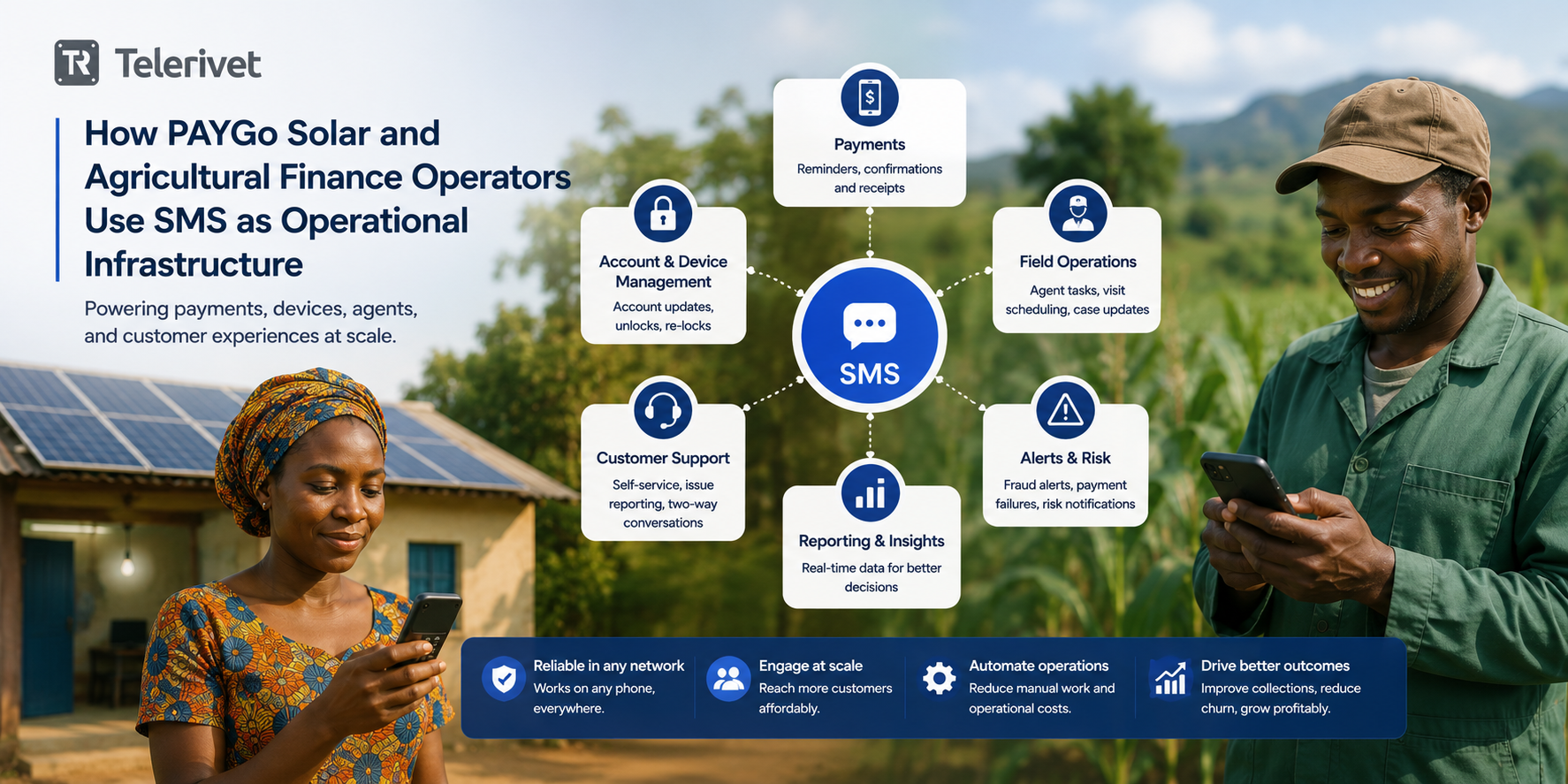
What the workflows actually look like
SMS payment reminders are often the first workflow operators build.
A customer's account approaches the end of its paid period. An automated reminder is sent in the appropriate language from a local number. The message includes payment instructions or mobile money details. The customer pays. The system receives confirmation and updates the account.
The complexity begins after the payment is made.
Mobile money confirmations arrive in different formats depending on the network and country. Those messages contain transaction references, payment amounts, sender information, and account identifiers. Automatically extracting that information and matching it to the correct customer account is critical.
Operators that process these confirmations manually create operational bottlenecks that become harder to manage as transaction volume grows. Operators that automate mobile money receipt parsing can process transactions, update accounts, and trigger downstream workflows without human intervention.
This becomes especially important when thousands of mobile money transactions are being processed every month across multiple countries. A delay in payment processing is not simply an administrative inconvenience. It can result in locked devices, frustrated customers, increased support requests, and higher churn.
Mobile money integration becomes a scaling requirement
For many PAYGo and agricultural finance businesses, mobile money integration sits at the center of daily operations.
myAgro, which operates SMS-based savings and payment programs for smallholder farmers in Mali, Senegal, and Côte d'Ivoire, built systems that allow farmers to save toward seeds and fertilizer through SMS and mobile money transactions.
Using Telerivet, myAgro supports voucher payment processing, balance inquiries via SMS, and automated Orange Money receipt parsing. Farmers can check balances, submit payment information, and receive account updates without requiring internet access or smartphone applications.
At the scale myAgro operates, automation is not simply a convenience. It is what allows the operational model to function efficiently.
The same principle applies across PAYGo solar and agricultural financing organizations. As transaction volume grows, reliable mobile money integration and automated payment processing become operational necessities.
Telerivet supports mobile money receipt parsing across major networks in Africa, APAC, Americas, EMEA. Talk to our team about how it works in your markets.
Field agent communication is often overlooked
Many PAYGo operators invest heavily in customer-facing communication while underinvesting in communication workflows for field agents.
This creates avoidable inefficiencies.
Field agents are often responsible for collections, customer support, onboarding, inspections, and account recovery activities. Their effectiveness depends on having timely and accurate information. Without automated communication systems, agents may rely on manual briefings, spreadsheets, printed lists, or informal coordination methods.
Operators that extend communication workflows to field teams often build capabilities such as automated risk alerts, account status lookups, collection assignment notifications, referral tracking, and survey and verification workflows. These systems help field teams focus their time on the accounts that need attention most.
Fraud detection is a use case many operators discover later
One of the less obvious applications of SMS infrastructure is fraud prevention.
Consider a unit replacement request. A replacement is recorded in an asset management system. Inventory is allocated. A new unit leaves the warehouse. If the replacement request was fraudulent or entered incorrectly, the operator may not discover the issue until the financial loss has already occurred.
An automated communication workflow can add a verification step. When a replacement request is logged, the customer receives a confirmation message asking whether they requested the exchange. If the response does not match the request, the issue can be investigated before inventory is lost.
What begins as a communication workflow becomes a risk management workflow. Many operators discover these opportunities only after communication systems are already integrated into operational processes.
Why communication infrastructure decisions matter early
Communication infrastructure choices are often made when a PAYGo business is relatively small. At that stage, many workflows can still be managed manually. Transaction volume is manageable. Operational complexity appears limited.
But the decisions made at 5,000 accounts can become significant constraints at 50,000.
Operators that build on infrastructure capable of handling mobile money integration, SMS automation, multi-country routing, local language workflows, and field agent communication from a single platform often scale more efficiently than operators managing separate systems for each function.
The challenge is not simply sending messages. It is coordinating operational workflows across customers, payments, field teams, devices, and support teams while maintaining reliability across multiple markets. The cost of changing communication infrastructure tends to increase as more business processes become dependent on it.
What to look for in a PAYGo communication platform
If you are evaluating communication infrastructure for a PAYGo solar, agricultural finance, or development finance operation, the most important questions go beyond whether a platform supports SMS.
Does it support automated mobile money receipt parsing for the networks you operate on? Can it manage multilingual communication across multiple countries from a single system? Does it support local numbers and routing options in each market? Can it automate workflows for both customers and field agents? Does it support Android Gateway deployments where internet connectivity is limited? And can it integrate communication, payments, and operational workflows without requiring multiple disconnected tools?
These capabilities often become more important as an organization grows.
Communication is infrastructure
For PAYGo operators, communication is not a customer engagement layer added after the business is built. It is the infrastructure that connects customers, payments, field agents, devices, and operations teams.
Every payment confirmation, account unlock, field visit, fraud alert, and customer support interaction depends on information moving reliably between those participants.
As operators scale from thousands to tens of thousands of financed assets, the question stops being whether they need SMS. The question becomes whether their communication infrastructure can support the operational complexity of the business they are building.
The most successful PAYGo and agricultural finance organizations tend to recognize this early. They invest in communication systems not as marketing tools, but as operational infrastructure that helps them collect payments, reduce risk, coordinate field operations, and serve customers at scale.
Frequently Asked Questions
How do PAYGo solar companies use SMS? PAYGo solar operators use SMS across three workflow types: payment-triggered workflows (a mobile money payment arrives and triggers account enabling, customer confirmation, and sometimes agent dispatch), outbound reminders (scheduled payment reminders sent before due dates, with escalation logic for missed payments), and two-way service communication (customers replying to request account status, report a fault, or confirm a field visit). The payment-triggered workflow is the most operationally critical because it runs in real time and directly affects service availability.
What is mobile money receipt parsing in a PAYGo context? Mobile money receipt parsing is the automated reading of incoming payment notifications typically an SMS from the mobile money provider to extract the transaction amount, sender ID, and reference number. The platform matches that data to the correct customer account and triggers the appropriate workflow: enabling the device for another period, updating the account balance, sending a confirmation to the customer. Without this parsing layer, the payment-to-service connection requires manual reconciliation.
How does SMS integrate with PAYGo account management systems? The integration typically works via API: when the PAYGo system processes a payment event, it sends a trigger to the messaging platform, which executes the customer-facing communication workflow. In the reverse direction, two-way SMS responses from customers - balance inquiries, fault reports are parsed and routed back into the account management system or to a field agent. The depth of integration determines how much of the workflow runs without human intervention.
What happens when a mobile money payment arrives but the account does not update? This is one of the most damaging failure modes in PAYGo operations: a customer has paid, but their device remains disabled because the payment was not matched to their account. The causes are usually data mismatches (wrong reference number, name variation) or system latency. A well-designed workflow includes exception handling: if a payment cannot be automatically matched, it is flagged for manual review immediately rather than sitting in a queue, and the customer receives an acknowledgment that the payment was received and is being processed.
Telerivet works with PAYGo solar operators and agricultural finance platforms across more than 150+ countries. If you are evaluating communication infrastructure for your operation lets talk:
