SMS fleet coordination is the use of automated and two-way SMS messaging to manage real-time communication between dispatchers, drivers, and customers across a logistics operation covering route assignments, pickup confirmations, delivery window notifications, proof-of-delivery requests, and exception alerts. It is an operational workflow, not a marketing channel: messages are triggered by dispatch events, delivery milestones, and driver status updates, not by campaign schedules.
Most logistics operators don't go looking for a messaging platform. They find one because they need a better way to manage fleet communication.
A dispatcher needs to confirm a pickup window. A manager needs to alert a driver about a route change. A customer needs to know their delivery is forty minutes out. These are operational problems, and in most markets, SMS solves them immediately. No app to download. No smartphone required. No dependency on internet connectivity at the point of delivery.
What starts as a practical fix becomes, for many operators, the layer their entire fleet coordination workflow runs on. This is true whether the operation manages local deliveries, regional transportation networks, or field service fleets. Messaging becomes the connective tissue between dispatchers, drivers, customers, and operational systems.
This post looks at how logistics operators actually use SMS for fleet coordination, where the manual approach stops working, and what the workflow looks like when it runs itself.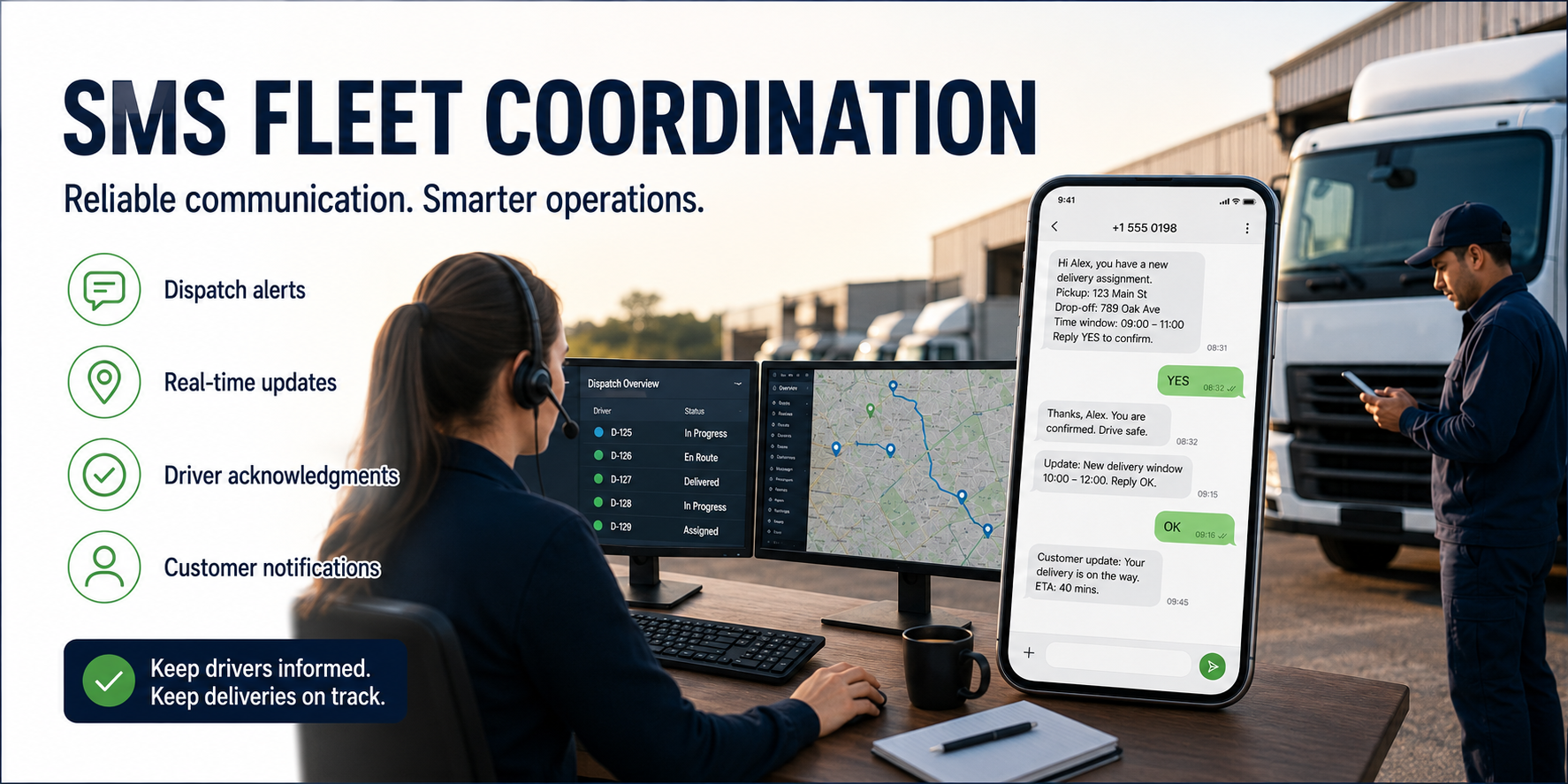
SMS becomes the coordination layer by default
Logistics operations generate constant communication between people and moving assets. Drivers need dispatch instructions. Customers need delivery windows and confirmations. Operations teams need visibility into what is happening on the ground.
For many operators, this communication happens across a mix of phone calls, messaging apps, and manual updates in dispatch software. The problem with that mix is coordination. Information lives in separate places. A driver confirms a delivery by WhatsApp. A different team member calls the customer. The dispatch record gets updated manually hours later.
SMS becomes the default fleet coordination channel because it works consistently across device types and network conditions. A driver using a vehicle-mounted Android device, an older handset, or a smartphone with intermittent connectivity can still receive messages reliably. SMS leaves a record and does not require the recipient to be running a specific application.
Asset Monitoring Solutions, which uses Telerivet for vehicle tracking and fleet management, reduced communication costs while improving driver and customer satisfaction. Eco Fuels Kenya extended coordination across its supply chain, reaching transporters, distributors, and operational teams from a single platform.
What the workflows actually look like
Dispatch alerts are usually the first workflow operators build. A driver is assigned a route. A message confirms the assignment, includes pickup details, and requests acknowledgment. The driver replies. The dispatcher sees confirmation without making a phone call.
Delivery notifications follow. Customers receive a message when a delivery is assigned, another when the driver is en route, and a final confirmation when delivery is complete. For last-mile delivery operations, these updates significantly reduce inbound calls asking for delivery status.
Route changes and operational updates come next. A pickup window shifts. A depot address changes. A driver is reassigned mid-shift. These updates need to reach the right person immediately, even when data connectivity is unreliable.
The pattern is remarkably consistent across operators and markets. The challenge is that in most cases, every one of these messages is still being sent by a person.
SMS and last-mile delivery messaging
The closer a delivery gets to a customer, the more communication matters.
Customers want accurate delivery windows. Drivers need route updates. Operations teams need visibility when delays occur. SMS remains one of the most effective channels for last-mile delivery messaging because it reaches customers regardless of device type, app usage, or internet connectivity.
A simple workflow keeps customers informed at each stage: confirmation when the delivery is scheduled, a notification when a driver is assigned, an alert when the driver is en route, and a final message when delivery is complete. Each update reduces uncertainty for the customer while lowering the communication burden on dispatch teams. For many operators, reducing inbound delivery enquiries is one of the first measurable results of moving to automated delivery notifications.
The manual ceiling
Logistics operators running SMS fleet coordination manually reach a predictable point. At lower volumes, a dispatcher can manage communication directly. At higher volumes, communication becomes the bottleneck.
A courier operation running cargo bikes, vans, and specialist vehicles needs different messages for different driver groups, routes, customers, and delivery types. Managing that manually across hundreds of drivers and thousands of deliveries often requires dedicated coordination staff whose primary responsibility is sending messages rather than solving problems.
Volume matters, but complexity matters more. A single fleet running a consistent route structure can remain manual for longer. Multiple fleet types, multiple customer segments, and multiple delivery workflows create coordination requirements that grow faster than the team responsible for managing them.
How two-way SMS coordination actually works
The starting point for most operators is keyword-based two-way messaging. It requires no custom software integration and runs alongside whatever dispatch system is already in place.
A driver texts CONFIRM to acknowledge a dispatch assignment. The system logs the acknowledgment and updates the job record. A driver texts DONE when a delivery is complete, triggering an automated confirmation to the customer. A customer texts STATUS to get an automated reply with their current delivery window. A driver texts HELP to trigger an escalation alert to the on-duty dispatcher.
These keyword triggers handle a large share of routine coordination. They create structure from what would otherwise be untracked conversations across phones and messaging apps, and because responses are logged automatically, the operations team has a record without manual data entry.
From there, automation can go further. When a delivery is assigned in a dispatch system, the driver notification fires without a human sending it. When a driver sends DONE, the customer confirmation and job closure happen in the same step. When a delivery window is missed, an alert goes to the dispatcher with the job reference and driver details. These are predictable, rule-based events, and automating them lets the coordination layer handle routine communication while the team focuses on exceptions.
Grab and Tata represent the larger end of this model, where the volume of coordination events makes automation a structural requirement. For smaller operators, keyword-based workflows are a practical starting point that can be built on incrementally as operational patterns become more predictable.
The channel question
SMS is the right channel for most markets. It is not the right channel for all of them.
A logistics company operating in the Western Balkans runs its fleet coordination through Viber rather than SMS. Drivers and warehouse staff use Viber as their primary communication tool. Running dispatch updates through SMS would mean relying on a channel employees check less frequently, with lower read rates and acknowledgment.
The coordination workflow is identical. Dispatch confirmations, route updates, delivery notifications and acknowledgments all follow the same operational logic. Only the channel changes.
This matters for logistics operators working across multiple countries or managing drivers from different regions. The infrastructure running fleet coordination needs to adapt to the channel that actually reaches people in each market, without operators rebuilding their workflows from scratch for each one. The same applies to device infrastructure: in markets where internet connectivity is limited, Android Gateway deployments allow operators to run SMS coordination through local SIM cards in vehicle-mounted devices, independent of cloud connectivity.
What to look for in a fleet coordination messaging platform
The questions that matter go beyond whether a platform supports SMS.
Can it send messages triggered automatically by events in your dispatch or fleet management system? Does it support two-way messaging with keyword-based auto-replies so drivers can acknowledge and report without a dispatcher involved? Can it manage different workflows for different fleet types or operational scenarios? Does it support the channels that actually reach your drivers, whether SMS, Viber, or WhatsApp depending on the market? And can it handle all of that from a single platform, without separate tools for each channel or region?
For operators running communication-dependent field operations, these infrastructure decisions tend to matter earlier than expected. The cost of switching platforms increases as more operational workflows become dependent on the one already in place.
Messaging is the coordination layer
For logistics operators, messaging is not a notification layer added on top of operations. It is the coordination layer connecting dispatchers, drivers, customers, and operational systems.
That layer works manually at lower volumes. As operations grow, manual coordination becomes increasingly expensive. Not because the technology fails, but because communication itself becomes a scaling challenge.
The question for most logistics operators is not whether SMS belongs in fleet operations. It already does. The question is whether fleet communication remains a manual process managed through calls, spreadsheets, and individual messages, or becomes operational infrastructure that scales alongside the business.
For growing fleets, that distinction becomes increasingly important.
Frequently Asked Questions
How do logistics operators typically use SMS? The most common uses are driver dispatch and route confirmation, customer-facing delivery window notifications, proof-of-delivery requests (asking drivers to confirm completion by SMS reply), exception alerts when a delivery is delayed or a driver is unreachable, and two-way check-ins for field agents or last-mile delivery personnel. Each is triggered by a dispatch event or delivery milestone, not a campaign schedule.
What is SMS fleet coordination? SMS fleet coordination is the operational use of SMS to manage communication flows across a logistics network in real time. A single dispatch event can trigger a chain of messages: a route confirmation to the driver, a delivery window notification to the customer, and a proof-of-delivery request at completion. These run automatically from the same trigger, without a dispatcher manually sending each one.
Can SMS integrate with fleet management software? Yes. SMS platforms with API access can integrate with dispatch systems, route planning tools, and operations management platforms via webhooks or direct API calls. When a driver's status updates in the fleet system, the messaging workflow triggers automatically. For organizations without custom development resources, logistics workflow templates can be configured without code using a platform with built-in conditional logic.
How does SMS compare to app-based communication for logistics in low-connectivity markets? App-based communication requires smartphones and reliable data connections. In markets where last-mile delivery involves drivers using basic handsets, or where routes pass through areas with poor data coverage, SMS is more reliable because it works on any phone and does not depend on internet access. For logistics operators covering mixed-connectivity environments, SMS is typically the reliable baseline, with app-based channels used where coverage and device quality allow.
Telerivet works with logistics and fleet operators across more than 100 countries. If you are evaluating communication infrastructure for your operation, let's talk through your specific setup.
