Field force communication is the system a business uses to coordinate between a central operations team and distributed field agents covering task assignment, check-ins, status updates, and exception reporting. At small scale, a group chat and a spreadsheet are sufficient. At 100+ agents, the absence of structured message routing, automated check-ins, and response tracking creates coordination failures that cost coverage, visibility, and operational control..
Most field force operations start with a WhatsApp, Viber or Text group and a spreadsheet.
For a team of ten or fifteen people, that works well enough. Someone posts the morning assignments. Agents reply when they've completed a visit. A manager scrolls back through the thread at the end of the day to tally who checked in.
Scale that to 100 agents, and the same system starts to collapse. By 300, it has usually failed in ways that are costing real money: missed visits that no one caught until a retailer complained, check-ins that arrived out of sequence, supervisors spending hours reconstructing activity from chat history instead of managing operations in real time.
The problem is not WhatsApp specifically. It is that informal coordination tools are not designed to handle operational complexity at scale.
Most organizations start with informal tools because building something more structured feels like an IT project. In reality, the first steps are often much simpler than that.
What Field Force Communication Actually Means
Field force communication covers a wide range of operations, but the core workflow is remarkably consistent.
A central team needs to dispatch tasks to a distributed workforce. Agents need to confirm receipt and completion. Managers need visibility into progress without chasing people individually. And the system needs to work across geographies where connectivity, device types, and network quality vary significantly.
An FMCG company sending trade representatives to hundreds of retail outlets faces this challenge. So does a microfinance institution coordinating loan officers across rural districts. So does an insurance company deploying field assessors in remote regions.
The use cases differ. The communication challenge is the same.
Where Traditional Approaches Break Down
The WhatsApp Group Problem
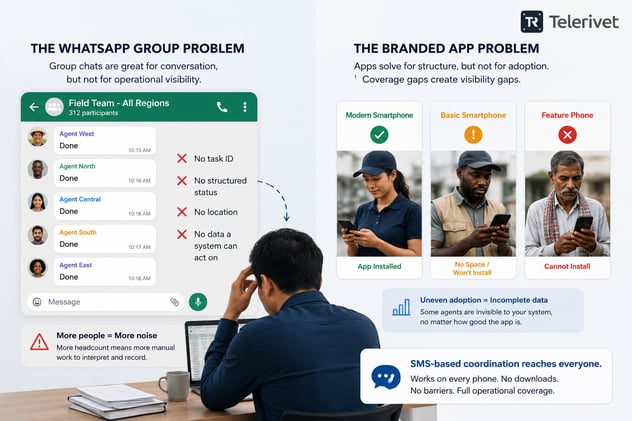
Group chats are excellent for conversation and genuinely poor at capturing structured operational data.
When an agent sends "done" into a group with hundreds of participants, that message contains no task identifier, no structured status update, and no information a system can act on automatically. Someone still has to interpret and record it.
As the operation grows, coordination effort grows alongside headcount.
The Branded App Problem
Dedicated field force apps solve the structure problem but often introduce an adoption problem.
Not every agent has a modern smartphone. Not every agent wants to download and maintain another application. In markets with high turnover or mixed device ownership, organizations can spend more time managing app adoption than managing field operations. SMS-based coordination avoids this entirely for the portion of your network where app adoption is lowest.
The result is often a technically elegant solution that never achieves full operational coverage.
The Phone Call Problem
Manual coordination through phone calls scales even worse. At 100 agents, a supervisor making individual calls can spend hours simply assigning work and collecting status updates. Every additional agent increases the workload. The system depends entirely on human effort to function.
What Scalable Field Force Communication Looks Like
The model that scales is built around two-way messaging rather than simple broadcasts.
-
A dispatch message goes out with a task reference. The agent replies with a keyword or code when they arrive, complete the task, or encounter an issue. Each response automatically updates a central record.The manager no longer needs to reconstruct events from chat history because the system is capturing structured information throughout the day.
-
A trade representative visiting a retailer might reply with an arrival code followed by stock counts.
-
A loan officer might confirm a collection visit and report the outcome.
- An insurance assessor might update claim status directly from the field.
Different industries. Same operational pattern. The communication channel becomes part of the workflow itself.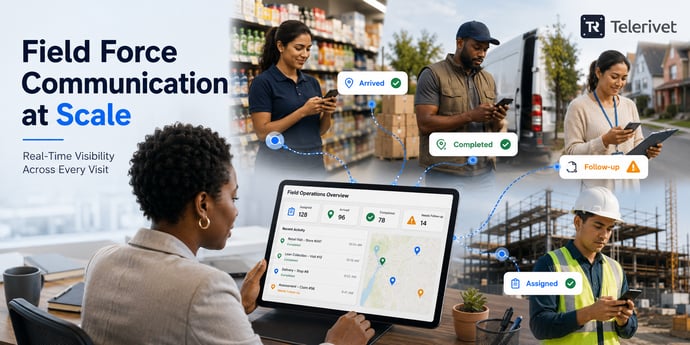
Designing for Real-World Connectivity
Any field force communication system designed exclusively for smartphone users with reliable data is designed for ideal conditions, not real operations.
Many field teams work in areas where connectivity is inconsistent. Devices vary. Mobile data may be unavailable or expensive.
SMS remains the most reliable communication layer because it reaches virtually every handset on every network. This is not a concession to low-end infrastructure. It is a recognition that reliable field force coordination has to work for every agent, not just the ones with the newest devices and strongest signal. WhatsApp and other messaging channels can run alongside SMS, with the system falling back automatically when a data-based message fails to deliver.
Reliable coordination requires consistency, not assumptions.
Incentives Can Strengthen Participation
One of the most effective and underused approaches in field operations is connecting incentives directly to communication workflows.
An agent who completes a target number of visits can receive an airtime reward immediately as part of the confirmation sequence. A representative who hits a weekly activity target gets recognition through the same channel they've been using to report all day.
The advantage is speed. When performance and rewards are connected through the same communication infrastructure, the feedback loop between effort and recognition closes in hours rather than weeks. For distributed workforces, that responsiveness has a measurable impact on participation and engagement.
A Practical Starting Point
Most organizations do not need to redesign their entire field operation overnight.
The best starting point is usually the point where visibility breaks down most consistently. For many teams, that is task confirmation. Agents report completion informally through calls, chat messages, or supervisor conversations. Those updates rarely create reliable records that managers can act on.
Replacing that single step with a structured two-way messaging workflow creates an operational data layer that previously did not exist. From there, additional automation becomes easier. Supervisors spend less time chasing updates. Managers gain real-time visibility. Escalations can be triggered automatically. Performance reporting becomes a byproduct of daily operations rather than a separate administrative burden.
That is the shift from informal coordination to communication infrastructure. And it can often be achieved using the devices, networks, and communication habits that field teams already use today.
Frequently Asked Questions
What is field force communication? Field force communication refers to the messaging and coordination systems that connect a central operations team with field agents - sales reps, delivery drivers, health workers, survey enumerators, or service technicians. Effective field force communication means agents receive clear task assignments, managers get real-time status updates, and exceptions such as a missed visit or an unreachable customer are reported and acted on without manual follow-up.
Why does field force communication break down at scale? Group chats and manual check-ins break at scale for a predictable reason: they require human attention at every step. A manager following up with 200 agents individually cannot maintain the same visibility they had with 20. The solution is structured workflows that automate task assignment and check-in requests, collect structured responses rather than free-text chat, and escalate exceptions automatically rather than waiting for a manager to notice a missing reply.
What tools are used for field force communication? The most common tools are SMS for reach in low-connectivity markets, WhatsApp for markets where it is the dominant communication channel, and purpose-built field operations platforms. The channel matters less than the workflow: automated task dispatch, structured response collection using yes/no, numeric, or keyword-based replies, and escalation logic for non-responses. A messaging platform with conditional workflow capability can cover most of this without custom development.
How do you automate field agent check-ins and reporting? Automated check-ins send a structured message to each agent at a defined time - "Reply 1 if your morning visits are complete, 2 if delayed, 3 if you need support" and route responses to a supervisor dashboard or trigger follow-up messages based on the reply. Agents who do not respond within a set window are flagged automatically. This replaces manual tracking and creates an auditable record of field activity without requiring agents to install an app or use any tool beyond their existing phone.
Telerivet helps organizations coordinate field teams, automate check-ins, collect structured responses, and manage operations across SMS, WhatsApp, and other messaging channels in more than 150 countries.
