A worker is injured at a remote site on a Friday night. Their crewmate calls a supervisor, who is off shift. The supervisor texts the site manager in the morning. The site manager mentions it to the safety lead on Monday. Somewhere in that chain, a legal clock has been running the whole time, because in Australia and New Zealand the duty to notify the regulator starts the moment the business becomes aware of the incident. Awareness travels exactly as fast as your reporting channel.
A workplace incident reporting workflow is a structured communication process that lets any worker report an incident or near miss from the field, routes that report up the chain of responsibility immediately, and produces a timestamped record of who reported what and when. In both Australia and New Zealand, that record is not administrative housekeeping. It is what the compliance framework runs on.
What the law asks for on both sides of the Tasman
Under Australia's model WHS laws, a person conducting a business or undertaking must notify the regulator immediately after becoming aware that a notifiable incident has occurred. Notifiable incidents include deaths, serious injuries and illnesses, and dangerous incidents, which means a near miss with no injury can still trigger the duty. The site must be preserved until an inspector arrives or releases it, and a record of each notifiable incident must be kept for at least five years.
New Zealand's Health and Safety at Work Act 2015 is built on the same model. PCBUs must notify WorkSafe as soon as possible after becoming aware of a notifiable event, preserve the site, and keep records for at least five years from the date of notification. New Zealand adds a sharpened edge: officers of the PCBU, including directors, carry a personal due diligence duty to ensure the business complies, and the duty to notify sits inside that.
The framework is also tightening rather than settling. Amendments to the model WHS Act published in December 2025 expand what must be notified, add a category of notifiable extended absence with a 14 day notice window, and amend the site preservation duty to explicitly require preserving evidence of the occurrence, including electronic and digital records and witness details. The amendments take effect as each jurisdiction adopts them, but the direction is unambiguous: digital communication records are now named in the model law as evidence.
Awareness is the trigger, and awareness is a communication problem
Here is the structural issue most operators miss. Every duty above is triggered by the business becoming aware. The regulator does not ask whether your safety manager was on shift. It asks when the business knew and what it did next.
An Australian transport company learned this the expensive way. A worker fell from a tilt tray truck and spent seven days in hospital with a fractured skull. A colleague reported the incident to the company's director on the day it happened. The regulator found out months later, and only because the injured worker made contact. The company was fined for failing to notify. The internal report was made. It reached a person. It never entered a system, so nothing that was supposed to happen next happened at all.
That failure pattern has nothing to do with intent and everything to do with channel. A report made by phone call or hallway conversation depends on the person who received it to act, remember, and document. A report that enters a structured workflow does not.
The half of the record most operators do not have
The compliance obligation runs in both directions, and so does the record. Workers are expected to report incidents up the chain, and businesses are expected to hold a current, retrievable account of what was reported and what was done. Most operators have invested in the outbound half: alerts, notifications, and increasingly proof of receipt for safety-critical messages. The inbound half, the worker's report, still lives in phone calls, paper forms back at the depot, and group chats that nobody can search six months later.
After an incident, an investigator's first questions land squarely on that missing half. When did the worker report it? To whom? In what words? What did the company do in the hours after? If the answers live in someone's memory or a chat thread on a personal phone, the business is reconstructing a timeline instead of retrieving one. And under the incoming amendments, those digital fragments are themselves evidence the business is expected to preserve.
What a working incident reporting workflow looks like
The workflow that closes this gap is not complicated, and it deliberately does not require the worker to do anything unusual under stress.
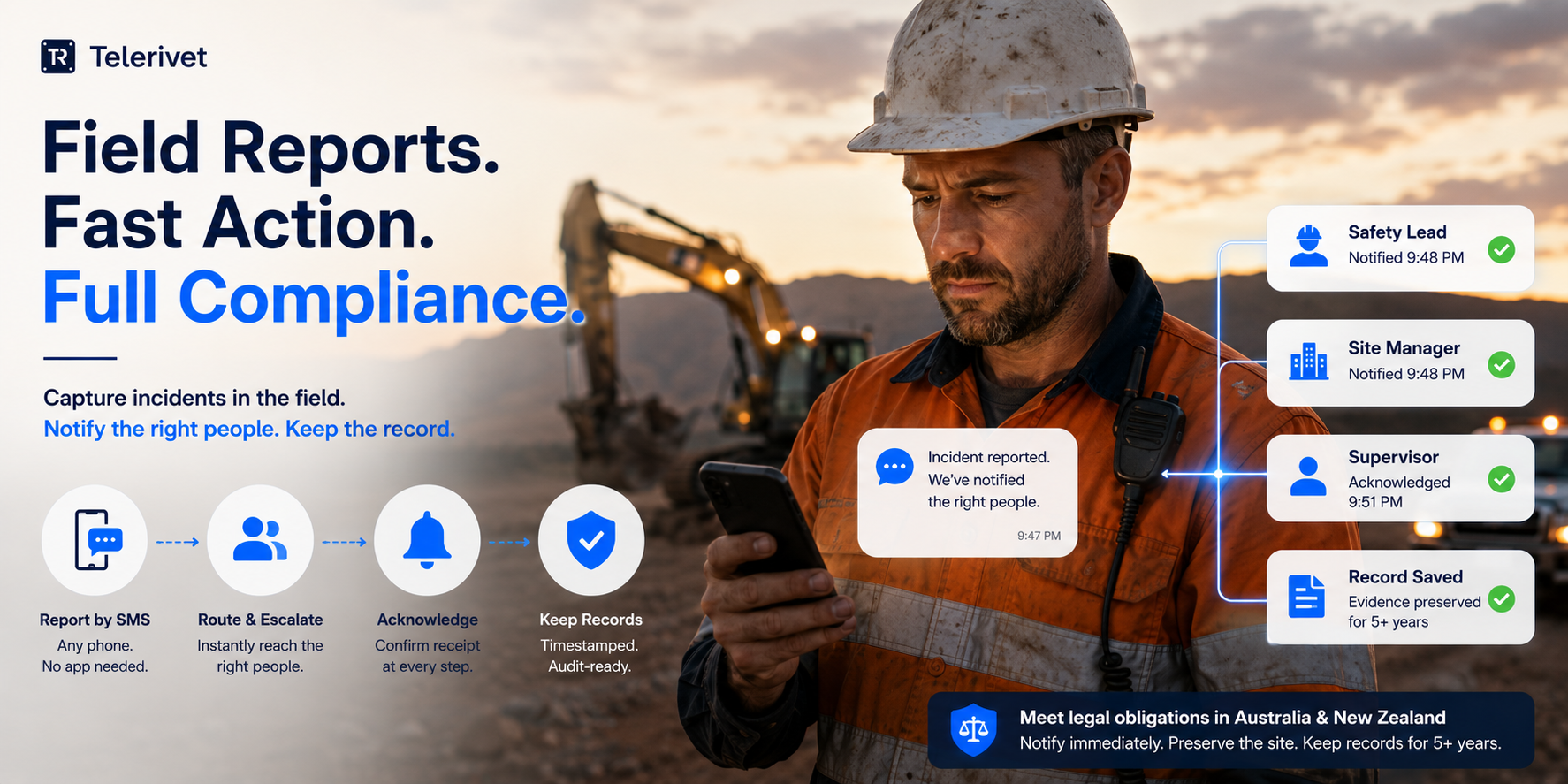
Any worker can send a report by SMS to a number they already know, from any phone, with no app, no login, and no data coverage required. The system replies with one or two structured prompts: where, what happened, is anyone injured. Each answer is captured and timestamped as it arrives.
The report is routed immediately based on what it contains. A report flagging an injury goes to the safety lead and the site manager at once, not sequentially. If the designated recipient does not acknowledge within a defined window, the workflow escalates to the next person in the chain, so a report can never again die in one inbox. The same routing logic that powers early warning and dispatch systems works in reverse here: the field is the source, and the office is the destination.
Every step generates the record as a byproduct. The worker's report at 9:47 pm. The supervisor's acknowledgment at 9:51. The safety lead notified at 9:52. When the business notifies the regulator, the internal timeline showing awareness and response is already assembled, and it is still retrievable five years later without anyone having filed anything.
Near misses are where the workflow earns its keep
Dangerous incidents that injure no one are notifiable in both countries, and they are chronically underreported for a simple reason: the only witnesses are field workers, and reporting a near miss through a paper form or a phone call to a supervisor costs effort that a non-event rarely feels worth. When reporting takes thirty seconds from the phone already in the worker's pocket, near miss data starts arriving. That data is the leading indicator every safety program says it wants, and the same channel workers use for check-ins during remote and isolated work is the channel they will actually use to report the guard rail that almost failed.
The pattern extends beyond safety. Once workers know the field can reach the office and something happens when it does, the same channel carries equipment faults, delivery exceptions, and site conditions, which we cover in When the Field Needs to Reach You.
Frequently asked questions
What is a notifiable incident under Australia's WHS laws? A death, a serious injury or illness requiring specified treatment such as hospital admission, or a dangerous incident that exposed people to a serious risk even if no one was hurt. The business must notify the regulator immediately on becoming aware, preserve the site, and keep a record of the incident for at least five years.
How is New Zealand different from Australia on incident reporting? The frameworks are closely aligned because HSWA was modeled on the Australian law. PCBUs notify WorkSafe as soon as possible after becoming aware of a notifiable event and keep records for at least five years. The notable difference in emphasis is that officers in New Zealand carry a personal due diligence duty to ensure the business complies, which puts directors' names next to the notification process.
Does an incident reporting system require workers to have smartphones? No. SMS-based reporting works from any phone on any network without an app or data coverage, which matters most at exactly the remote sites where incidents are hardest to report. Workers with smartphones can report through channels like WhatsApp on the same workflow. Our guide to choosing the right messaging channel covers the tradeoffs.
What records should an incident reporting workflow produce? A timestamped sequence covering the worker's original report, the structured details captured, who was notified and when, who acknowledged, and what escalations occurred. This internal timeline is separate from the notification to the regulator, but it is what demonstrates the business acted on awareness, and it should remain retrievable for the full retention period.
This article provides general operational information and should not be considered legal advice. Organizations should consult qualified legal or workplace safety professionals regarding their specific compliance obligations.
Build the reporting channel before the investigator asks for it
If a worker at your most remote site witnessed a dangerous incident tonight, the honest question is whether their report would enter a system or a chain of phone calls. Talk to Telerivet about building an incident reporting workflow that captures the field report, routes it up the chain, and keeps the record.
