It is 5:30 a.m. A dispatcher sends a route condition update to a group chat on their personal phone. Fifteen drivers are in that group. Some are already on the road. Some have not left the terminal. At least two have the chat on mute.
Three weeks later, after an incident, one of those drivers says they never received the update. The dispatcher knows they sent it. But the group chat is gone, the thread is fragmented across personal devices, and there is no record that establishes who was in the group at the time, when the message was sent, or which drivers the carrier can reasonably claim were notified.
That gap is the problem. And for Canadian carriers operating across provincial lines, it is not just an operational inconvenience. It is a compliance exposure that sits squarely inside a worker notification requirement most dispatchers do not know they carry.
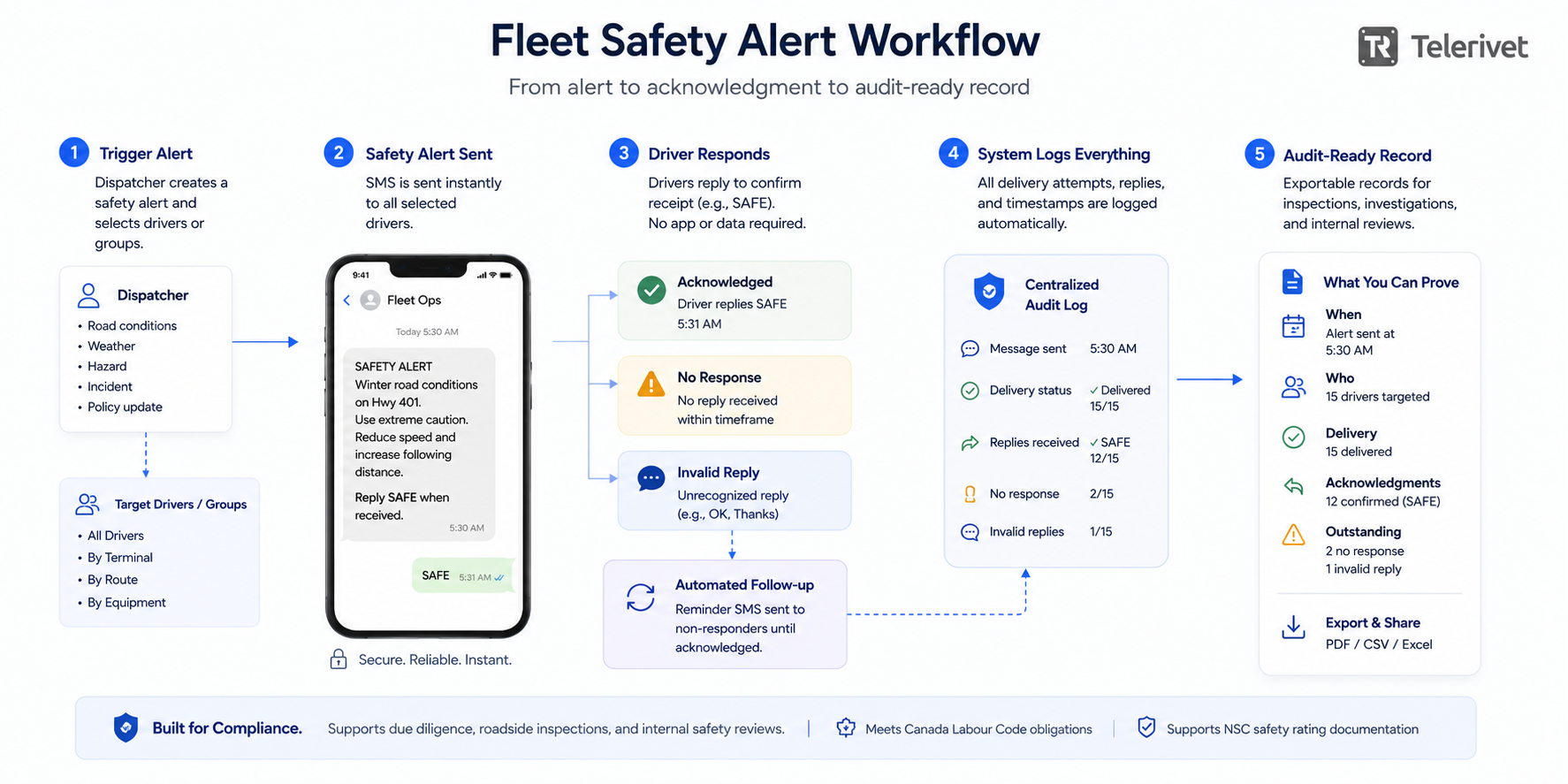
A safety alert notification record for a fleet operation is a centralized, timestamped log showing which drivers received a given safety-critical message, when it was sent, whether delivery was attempted, and where an acknowledgment step was included, which drivers confirmed receipt. It is the difference between a dispatcher who sent a message and a carrier that can demonstrate its safety communication obligations were met in a structured, documented way.
What Canadian Law Requires of Carriers
Canada's occupational health and safety framework is split between federal and provincial jurisdiction. For carriers operating across provincial borders, which covers most long-haul and interprovincial trucking, the relevant federal law is Part II of the Canada Labour Code. Under Section 125 of the Code, employers are required to ensure that each employee is made aware of every known or foreseeable health or safety hazard in the area where they work. The Code also requires that employers provide the information, instruction, and supervision necessary to protect worker health and safety, and that employers use communication methods that are appropriate for the workforce and capable of effectively conveying safety-critical information.
The Code further requires that employers investigate, record, and report all accidents, hazardous occurrences, and near-misses known to the employer. When an incident leads to an investigation, a Labour Program health and safety officer reviewing a carrier's records will look at whether hazard information was communicated to the relevant workers. Personal phone messaging often lacks the centralized governance, retention controls, and auditability organizations typically look for when documenting safety communications.
For Ontario-based operators, the Occupational Health and Safety Act was amended under Bill 190, which received Royal Assent in October 2024. One practical change from that legislation: organizations can now maintain required safety documentation electronically rather than relying solely on paper records. SMS delivery logs and worker acknowledgments can form part of those electronic records when used as part of a broader safety communication process. For carriers who have been running safety communications through informal channels, this is a clear prompt to build a system that generates records in a recognized format.
Provincially, both Alberta and British Columbia have OHS codes with explicit requirements for procedures to communicate hazard information to workers. The National Safety Code for Motor Carriers, administered through the Canadian Council of Motor Transport Administrators, governs carrier safety ratings across all participating jurisdictions. Documentation of safety management practices may be considered as part of carrier oversight and safety management reviews under that framework.
The Dispatcher's Role in Carrier Safety Communication
Dispatchers often play an important role in helping employers meet their health and safety communication obligations. Under both the Canada Labour Code and provincial OHS frameworks, the obligation to communicate known hazards to workers extends through supervisory and coordinating roles, and dispatchers who assign trips, communicate route conditions, and instruct drivers on operational requirements are part of how carriers fulfill that obligation in practice. When something goes wrong and a driver's account of what they were told differs from the carrier's, the communication record behind the dispatcher's process is part of what gets examined.
The before state in most Canadian fleet operations is not a policy failure. It is a tools failure. Dispatchers are not cutting corners deliberately. They are using the fastest available channel, usually a personal phone or a shared messaging app, because there is no purpose-built alternative that is simple enough to use at dispatch speed. The result is a communication history that is fragmented, uncontrolled, and unavailable to anyone outside the personal device it sits on.
Why field force communication breaks down at scale is worth reading for context on how this failure compounds as fleet size grows. The safety alert problem is one dimension of a broader coordination gap that becomes more expensive the longer it goes unaddressed.
Transport and Logistics: Where the Exposure Is Sharpest
For carriers running heavy vehicles interprovincially, the worker notification requirement under the Canada Labour Code applies to every driver on every route. Route condition changes, site access restrictions, hazardous weather alerts, and operational safety updates are all foreseeable hazards that a carrier is expected to communicate. The question a regulator or investigator will ask is not whether the dispatcher intended to inform the driver. It is whether the carrier has a communication process that is structured, logged, and demonstrable.
This is a different problem from fleet coordination, though the two are adjacent. How logistics operators use SMS for fleet coordination covers the dispatch and operational communication layer. Safety alert notification sits alongside that: it is specifically the communication that carries a safety communication obligation, requires confirmation that the right people were reached, and needs to be retrievable if the carrier is ever asked to show its records. The workflow for safety alerts is best kept separate from general dispatch communication precisely because the evidentiary standard is higher.
The inbound layer matters here too. When drivers can reply to a safety alert to confirm receipt, and that reply is automatically logged, the record is complete in both directions. Handling inbound communication from the field covers how that side of the workflow operates in practice.
Construction and Resource Operations
The same communication responsibilities apply to construction operators and resource companies whose workers move across sites, work in isolation, or operate in conditions where hazard information changes throughout a shift. Provincial OHS codes in Alberta, British Columbia, and Ontario all require procedures for communicating hazard information to workers, and a procedure that generates no record is considerably harder to demonstrate during an investigation.
For subcontractor-heavy operations, the communication challenge is more complex. When a principal contractor shares a site with multiple subcontractors, the obligation to communicate safety-critical changes does not end at the boundary of direct employment. Building a contact group structure that covers all workers on a site, regardless of which company employs them, and broadcasting from a single controlled platform rather than through whoever has the right person's number, is the operational response to that complexity.
What the System Looks Like in Practice
The reason most Canadian fleet operators have not built a formal safety alert system is not that the problem is invisible. It is that they assume the solution requires an IT project. It does not.
A centralized SMS safety alert system for a fleet of twenty to one hundred drivers requires no integration with existing telematics, no API configuration, and no developer involvement to set up and run. Contact groups are created by role, route, or location. Authorized senders, typically the dispatcher, the Safety Manager, and the Operations Manager, are assigned send permissions for the relevant groups. A message goes out, drivers reply to confirm receipt, and the log is there the moment anyone asks for it. For carriers who do want to connect the system to existing fleet management software or dispatch platforms, that integration path is available, but it is a later-stage decision, not a prerequisite for getting started.
For operators deciding on the right channel for this workflow, the knowledge base guide to messaging channels in Telerivet covers the practical tradeoffs. For most Canadian fleet operations, SMS is the right default: it reaches every device, does not require a data connection or a smartphone, and works across the remote stretches of highway where app-based communication regularly fails.
The Same Problem Across Borders
The specific legislation named in this post is Canadian. The underlying accountability problem is not. Australian fleet operators are working against a different compliance framework, including the amended Heavy Vehicle National Law commencing August 1, 2026, which introduces mandatory auditable Safety Management Systems for accredited carriers. UK operators work under the Health and Safety at Work Act 1974 with equivalent evidentiary expectations around worker notification. The question a regulator or investigator asks is consistent across all of these jurisdictions: were your workers notified, and can you demonstrate it? For a full treatment of how the Australian compliance context shapes this problem, the safety alert records post for Australian field operations covers the regulatory detail specific to that market.
Frequently Asked Questions
Does the Canada Labour Code require carriers to keep records of safety communications with drivers? Part II of the Canada Labour Code requires federally regulated employers, including interprovincial carriers, to ensure each employee is made aware of every known or foreseeable hazard in their work area, and to investigate, record, and report all accidents and hazardous occurrences. While the Code does not prescribe a specific communication technology, carriers are generally better positioned during investigations and regulatory reviews when they can produce clear, timestamped records showing how safety-critical information was communicated to drivers and, where applicable, acknowledged. Personal phone messaging often lacks the centralized governance and retention controls organizations typically look for when documenting those communications.
Does Ontario's Bill 190 change how carriers can document safety communications? Bill 190, which received Royal Assent in October 2024, amended Ontario's Occupational Health and Safety Act to recognize electronic documentation as an acceptable format for mandatory OHSA safety records. Organizations can now maintain required safety documentation electronically rather than relying solely on paper records. SMS delivery logs and worker acknowledgments can form part of those electronic records when used as part of a broader safety communication process, giving carriers a clear basis for building a structured digital system rather than relying on informal channels.
What role do dispatchers play in a carrier's worker notification obligations? Dispatchers often play an important part in how carriers fulfill their safety communication responsibilities in practice. Under the Canada Labour Code and provincial OHS frameworks, the obligation to communicate known hazards extends through supervisory and coordinating roles. When an incident leads to a review of whether a driver was informed of a relevant hazard, the communication process behind the dispatcher's workflow is part of what regulators and investigators may examine. A dispatcher communicating through a personal phone or informal group chat may find it significantly harder to demonstrate that information was conveyed in a controlled, documented way.
Do small and mid-sized carriers need a formal safety alert system, or is this only for large fleets? The Canada Labour Code worker notification obligation applies to federally regulated employers regardless of fleet size. A carrier with fifteen drivers operating inter-provincially has the same safety communication responsibilities toward those drivers as one with five hundred. The practical argument for a structured system is proportionally stronger for smaller operations: a Safety Manager or dispatcher at a mid-sized carrier typically cannot absorb the overhead of manually tracking who received what. A centralized SMS system with automatic logging handles that without adding headcount.
Does setting up a safety alert system require integration with existing dispatch or telematics software? No. A centralized SMS safety alert system can be set up and operated independently of any existing fleet management or telematics platform. Contact groups, send permissions, and acknowledgment workflows are configured within the platform itself. For carriers who later want to connect the system to existing dispatch software or custom internal tools, that integration path is available, but it is not required to get started.
This article provides general operational information and should not be considered legal advice. Organizations should consult qualified legal or workplace safety professionals regarding their specific compliance obligations.
Ready to build a safety communication system that helps support your workplace safety communication and recordkeeping processes? Talk to our solution engineers about how mid-sized Canadian carriers have implemented structured, auditable safety alert workflows.