Ask a high-volume sender what they value in a messaging platform and you will hear about deliverability, routing, and cost per message. Almost nobody says opt-out handling. Yet when we listen to what enterprise operators actually cite as their top value drivers after a year of running campaigns across multiple countries, automated opt-out handling keeps appearing near the top of the list. One global event operator named it among their top three.
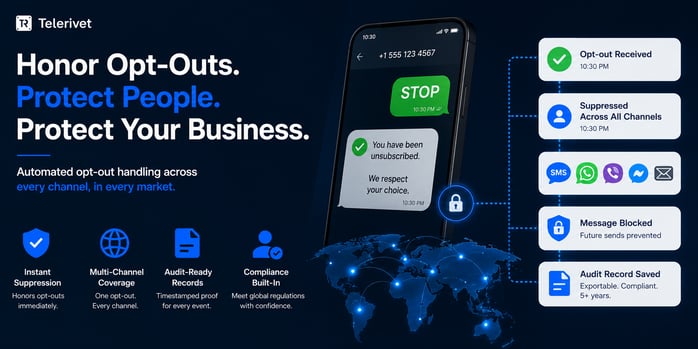
That gap between what buyers evaluate and what operators come to value is worth examining, because the industry frames opt-out handling wrong. Opt-out compliance is the practice of detecting an unsubscribe request on any channel, in any market, immediately suppressing that contact across every channel you use to reach them, and keeping a timestamped record of when the request arrived and how it was handled. The suppression protects the recipient. The record protects you. Everything in this post follows from that pair.
The Recipient Holds the Authority
Before the mechanics, the principle. An opt-out is not a preference setting your organization graciously accommodates. It is the recipient exercising authority over their own attention, and every major regulatory regime in the world treats it that way. The moment someone says STOP, the legal and ethical basis for the next message is gone. Organizations that internalize this build trust with the audiences they keep. Organizations that treat it as list hygiene eventually meet a regulator, a carrier, or a class action lawyer who explains it to them.
The Rules Are Multi-Market, and They Include Paperwork
Most operators know they must honor unsubscribes. Fewer know that in several major markets, honoring them is not enough. You must also be able to prove you did.
In Canada, anti-spam legislation requires businesses to keep records of both opt-in and opt-out preferences, with penalties reaching into the millions of dollars per violation. In Australia, the Spam Act puts the burden of proof on the sender: if a complaint reaches the regulator, it is up to you to demonstrate consent existed and that the opt-out was processed within the required five business days. In the United States, TCPA statutory damages run per message, and the available safe harbor defenses depend on being able to produce consent records and evidence of proper opt-out handling. One US retailer settled for $4.4 million in 2025 over allegations it kept texting people who had unsubscribed. In Singapore, marketing to local numbers requires checking against the national Do Not Call registry, and an opt-out is permanent: re-adding a contact without fresh consent is itself a violation. Across the EU and UK, data protection law requires organizations to be able to demonstrate consent and its withdrawal, on top of channel-specific rules. Markets like the Philippines have added their own requirements in recent legislation, and the direction of travel everywhere is stricter.
The pattern across all of these: the regulation is not just "stop sending." It is "stop sending, quickly, everywhere, and keep the receipts."
Why the Record Is the Product
This is where the checkbox framing of opt-out handling collapses. When a regulator, an auditor, or opposing counsel asks when an opt-out was received and honored, the acceptable answer is a timestamp, not a recollection. A compliance-grade opt-out system therefore produces an exportable audit trail as a matter of course: the inbound message or event that expressed the opt-out, the time it was received, the channel it arrived on, the time suppression took effect, and every subsequent send attempt that was blocked as a result.
For an organization sending across eight or ten markets, that report is the difference between a compliance inquiry being an afternoon of exports and being a crisis. It is also what turns opt-out handling from a cost center into risk transfer. Every message sent after consent is withdrawn is a discrete liability event with a price attached in statute. Automation collapses the window between request and suppression to zero, and the record proves the window was zero. No queue, no interpretation lag, no dependence on someone being at a desk when a STOP arrives at 3 a.m. in a language your team does not read.
The reputational half matters too. Carriers monitor complaint rates, and senders who mishandle opt-outs degrade deliverability for everything they send, including the attendance reminders and transactional messages their business actually runs on. The same logic applies to protecting a rewards program from abuse: the unglamorous control work is what keeps the valuable channel usable.
One Opt-Out, Every Channel
People do not opt out politely, consistently, or on the channel you expect. They reply STOP, stop please, unsubscribe, remove me, or the equivalent in another language. They opt out on WhatsApp from a program they joined via SMS. Regulators increasingly read consent withdrawal as applying to the sender relationship, not just the channel it arrived on, which means suppression has to apply platform-wide: an SMS opt-out honored on the Viber and WhatsApp side of the same program, automatically, including against campaigns already scheduled. If your channels live on separate tools with separate suppression lists, this is nearly impossible to guarantee. When they run through one workflow layer, it is one rule.
The Exception That Requires a Process, Not an Override
There is one category where a blind suppression rule is genuinely the wrong design: operational messages to your own people. A driver who replies STOP to a safety alert group, a nurse who unsubscribes from shift notifications, a field technician who opts out of dispatch messages. These are not marketing relationships, and silently dropping that person from safety-critical communication can create a different and more serious risk.
The answer is never to override the opt-out. It is to treat it as an event that triggers a documented review workflow. The opt-out is logged and honored immediately, a supervisor is notified, and a conversation happens: why did you opt out, and here is the explicit re-opt-in step if these messages are a condition of the role. The platform can generate the transactional record of that entire exchange, including the notice sent, the response received, and the re-consent captured, so that both the recipient's agency and the organization's duty of care are documented. That is a materially better position than either ignoring the opt-out or pretending it did not happen.
What Good Looks Like
An opt-out system worth relying on has five properties. It recognizes unsubscribe intent across keyword variants, not just STOP. It applies suppression across every channel and route in the account. It takes effect immediately and automatically, including against scheduled and in-flight campaigns. It produces an exportable, timestamped audit record of every opt-out and every suppressed send. And it supports a documented review and re-consent workflow for the narrow class of operational messages where dropping someone silently creates its own risk.
If your current setup cannot demonstrate all five, the exposure is already on your books. It just has not been invoiced yet.
Frequently Asked Questions
Which countries require keeping records of opt-outs? Canada's anti-spam legislation explicitly requires records of opt-in and opt-out preferences. Australia places the burden of proof on the sender, which makes records a practical necessity. US TCPA safe harbor defenses depend on producing them. EU and UK data protection law requires organizations to demonstrate consent and its withdrawal. In practice, if you send into more than one market, maintain the records for all of them.
Does an opt-out on one channel apply to other channels? It should. Regulators increasingly interpret consent withdrawal as applying to the sender relationship rather than the channel, and suppressing platform-wide is both the safer legal posture and the better recipient experience. If you are deciding which channels belong in a program in the first place, start with our guide to choosing the right messaging channel.
What happens to messages already scheduled when someone opts out? In a properly automated setup, suppression applies before send time, so scheduled and in-flight campaigns skip the contact, and the blocked sends appear in the audit record. If your platform cannot guarantee this, the gap between opt-out and next send is unmanaged liability.
Can we re-contact someone after they opt out? For commercial messages, only with fresh, explicit consent, and in some markets re-adding them without it is itself a violation. For operational messages to staff or contractors, use a documented review and re-opt-in workflow rather than any form of override, and keep the record of that exchange.
How fast do opt-outs have to be processed? It varies: Australia specifies five business days, Canada ten, and other regimes use language like promptly or without undue delay. Automation is the only approach that reliably meets the strictest timeframe you are subject to across all your markets at once, and it is why instant processing is the standard worth holding.
This article provides general operational information and should not be considered legal advice. Organizations should consult qualified legal or workplace safety professionals regarding their specific compliance obligations.
If you are sending at volume across more than one market, the question is not whether you have an opt-out policy. It is whether it executes itself and can prove it did. Ask us how opt-out handling and audit reporting work across every channel in your account.
