Transactional SMS in the Philippines refers to automated, triggered messages sent to an individual recipient as a direct result of an action they have taken: a login attempt, a transaction confirmation, a disbursement alert, or a payment notification, as distinct from promotional or marketing messages sent to a contact list. The distinction matters because transactional SMS is routed differently by Philippine telcos, priced differently, and regulated differently by the Bangko Sentral ng Pilipinas, especially with Circular 1213 in the picture now..
Here is a failure mode Philippine fintech teams encounter more often than they admit: a borrower submits a loan application, reaches the OTP verification step, and the code does not arrive within the authentication window. The session times out. The borrower tries again. The second OTP arrives alongside the first. Neither works because both have expired. The borrower gives up.
This is not a rare edge case. It is a predictable outcome when SMS OTP delivery is treated as a commodity integration rather than a system designed for how Philippine telco networks actually behave. This guide covers what banks, lending companies, e-wallets, and fintechs need to understand before they build, and what to fix if the current setup is already causing delivery problems.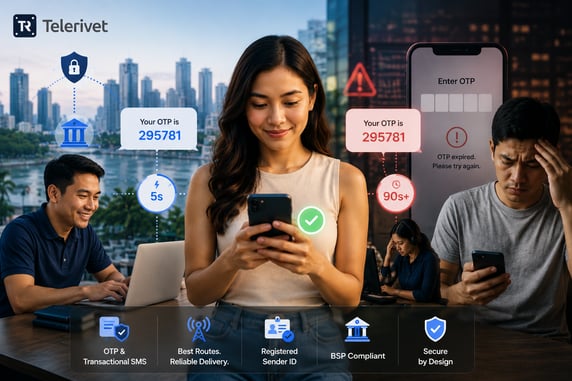
Why OTP Delivery in the Philippines Is Harder Than It Looks
The Philippine mobile market runs on two dominant carriers. Globe Telecom and SMART Communications (with sub-brands TNT and Sun) together account for the vast majority of mobile subscribers, with DITO Telecommunity holding a smaller and growing share. Every SMS your platform sends is routed through one of these networks, and the routing path determines delivery speed, reliability, and whether your message gets through at all.
Philippine telcos distinguish between transactional SMS routes and standard or promotional routes, and the delivery behavior differs materially between them. Standard shared routes carry higher volume, operate under more variable queue conditions, and are more likely to throttle during peak periods. Transactional routes are designed for low-latency, high-priority delivery: the kind of SLA that a 60-second OTP window actually requires.
When a lending company or e-wallet signs up with an SMS aggregator and takes the default route assignment, they often end up on a shared route designed for promotional throughput. That route may deliver reliably during off-peak hours and degrade under load, exactly when authentication volume is highest, during a loan disbursement campaign or a payday rush on a mobile wallet. The delivery complaints that follow are accurate descriptions of a real problem. The fix is a routing decision, not a platform switch.
Globe and SMART also behave differently from each other in ways that matter for latency. Messages through certain configurations arrive on Globe subscribers within seconds and take significantly longer on SMART, or vice versa, depending on the aggregator relationship and the specific route in use. Fintechs running detailed delivery reporting often see this as a bimodal distribution: one cluster of messages that arrive immediately and another that takes 60 to 90 seconds, split along network lines.
The Sender ID Problem
Following the SIM Registration Act and subsequent NTC guidelines, Philippine businesses sending automated or bulk SMS must register a sender name rather than transmitting from an unregistered numeric shortcode. The policy was designed to reduce scam messages impersonating banks and government agencies, and unregistered sender IDs are increasingly filtered or blocked before delivery.
For fintechs and lenders, the implication is direct: if your OTP messages are transmitting from an unregistered or generic sender ID, they are at meaningful risk of being silently filtered by telco spam detection. The recipient sees nothing. No error is returned to the sending platform. Your delivery reporting shows the message as sent. Your customer is waiting for an OTP that will never arrive.
Sender ID registration also requires separate filings with Globe and SMART. A sender ID that clears one carrier's whitelist does not automatically clear the other's. Sporadic non-delivery concentrated on a single network is often a whitelist gap rather than a routing problem. The Philippines business messaging compliance post covers the registration process, domestic versus international sender ID classification, and the documentation required for financial services institutions.
BSP Circular 1213 and What It Means for Your SMS Flows
The most significant recent regulatory development for Philippine fintech SMS is BSP Circular 1213, issued in June 2025 under the Anti-Financial Account Scamming Act (Republic Act 12010). It applies to all BSP-supervised institutions: commercial and digital banks, e-money issuers, payment system operators, credit card issuers, lending firms, and remittance companies. The compliance deadline is June 30, 2026, and BSP Deputy Governor Elmore Capule has confirmed it will not be extended.
The headline requirement is frequently misread. Circular 1213 restricts the use of SMS and email OTPs as the authentication factor for login and high-risk transactions, including adding a new payee, changing registered contact details, and initiating large transfers. For those flows, covered institutions must move to stronger mechanisms: biometric authentication, behavioral biometrics, FIDO security keys, or adaptive authentication. This does not eliminate SMS OTP from the workflow.
SMS OTP remains valid for two categories. The first is confirming mobile number ownership at enrollment. The second is transaction notifications, provided the message is personalized with sufficient detail: recipient name, amount, date and time, transaction type, and a reference number the customer can verify. A bare six-digit code with no context no longer meets the standard.
The circular also restricts sending clickable links or QR codes via SMS unless the link was prompted by a prior customer action, provides information only, and does not redirect to a page requesting credentials. Any SMS template carrying an embedded short link should be reviewed against this rule before the deadline.
The practical effect for fintech messaging programs is a reshaping of OTP volume, not its elimination. The architecture covered below applies to the SMS authentication and notification traffic that remains.
Building the OTP Architecture That Holds Up
Dedicated transactional routing. The OTP and authentication flow should be on a route explicitly designated for transactional traffic, not shared with promotional campaigns, not on a default aggregator path. Ask your provider one specific question before you build: is this a dedicated transactional route, and what is the delivery SLA during peak load? Get the answer in writing before a disbursement event tests it.
Message design for the authentication window. A 60 to 90 second OTP window is significantly more forgiving than 30 seconds for a market where delivery latency can reach 45 to 60 seconds on certain routes under load. Where there is product flexibility, extending the window reduces authentication failures caused by delivery timing rather than user error. The message itself should contain the OTP code, an expiry statement, and a brief brand name. Long messages with embedded links cost more per segment and are more likely to trigger spam filters.
Delivery monitoring. Philippine telcos return delivery receipts on transactional routes. Monitoring latency distribution, not just overall delivery rate, is what lets you catch route degradation before it becomes a flood of support complaints. A sudden shift in the latency distribution on one network is the signal to investigate, not the first customer complaint.
Fallback logic. When a transactional SMS goes undelivered after 60 seconds, a fallback to a second route or a second channel should trigger automatically. This is where communication orchestration logic earns its cost: instead of manually diagnosing a delivery failure after the fact, the workflow escalates on its own. The failover architecture post covers how to build escalation sequences that handle this in practice. Most lending companies build fallback in after their first significant delivery outage. The better approach is to design it in from the start.
Lending and Banking Workflows That Depend on Transactional SMS
Transactional SMS is not only an authentication channel for Philippine banks and lenders. It is the communication layer that runs the full borrower journey. Automated loan payment reminders sent before and after a due date consistently reduce late payments and collections effort. Disbursement confirmations sent immediately when funds transfer close the loop with borrowers and reduce inbound inquiries. Overdue escalation sequences routed to field agents or collections queues run automatically once configured.
Mobile money receipt parsing sits alongside these workflows as an operational requirement, not an optional enhancement. When borrowers repay via M-Pesa, GCash, or a similar service, the payment confirmation arrives as an inbound SMS. Automating the match between that confirmation and the correct account eliminates manual reconciliation and triggers the downstream sequence immediately: account update, repayment confirmation to the borrower, field agent notification if the account is now current.
Two-way communication is the third layer. Borrowers have questions about repayment schedules, balances, and product terms. Building a two-way messaging channel into the lending operation routes those inquiries to the right queue rather than a dead inbox, and creates the audit trail that BSP requires for supervised institution communications.
For the broader channel picture in the Philippine market, including how SMS, Viber, and WhatsApp each serve different segments of a financial services customer base, the channel guide for Philippine businesses covers the channel selection logic in full. And for fintechs operating across multiple emerging markets beyond the Philippines, the fintech and mobile money messaging post addresses the multi-country architecture question.
Viber as a Fallback for OTP: Where It Works and Where It Does Not
Viber-based OTP is technically possible and works well in specific conditions: the recipient is a known app user, the authentication window is longer than 60 seconds, and the message contains richer context than a plain SMS code can carry. A loan approval notification with embedded signing instructions is a reasonable Viber OTP use case.
The case against Viber as a primary OTP channel for a Philippine lending or banking product is clear. It requires the recipient to have Viber installed, push notifications active, and a data connection at the moment of authentication. These conditions are not universally met by Philippine borrower populations, particularly in provincial markets where data connectivity is less consistent.
The design that works: SMS as the default OTP channel for all customers, with Viber available as a customer-selected option for verified app users who prefer it. A fintech that sends OTPs via Viber and falls back to SMS on non-delivery is well-designed. One that sends OTPs via Viber only is excluding the segment of its customer base that most needs access to financial services. If you're still not sure which to choose: SMS, Viber or even WhatsApp, read out channel guide here.
Common Failure Modes and How to Diagnose Them
OTPs arrive late consistently. Check whether delivery latency is uniform across all recipients or split along Globe and SMART network lines. If it is network-split, the issue is route configuration. If it is uniform, the issue is likely queue depth on a shared route during peak periods. The fix is a route change.
OTPs do not arrive at all for a subset of users. Sporadic non-delivery at sub-10-percent rates is often sender ID filtering. Check whether affected recipients are concentrated on a specific network. If they are, the sender ID may be registered on one carrier's whitelist but not the other's.
Delivery reports show successful delivery but customers report non-receipt. This indicates a discrepancy between the telco's delivery confirmation and actual handset delivery. It is common when a subscriber has changed devices and the number is mapped to a new SIM. The telco delivers to the network endpoint and returns a receipt; the message never reaches an active handset. Validate contact numbers against active SIM data at onboarding where possible.
OTP delivery fails during disbursement surges. A lending company disbursing loans to 2,000 borrowers in a two-hour window generates simultaneous OTP demand that standard routes are not designed to handle. A dedicated high-throughput transactional route is the correct solution. Load-test the workflow before a disbursement event, not after.
Frequently Asked Questions
What is transactional SMS in the Philippines? Transactional SMS refers to automated messages triggered by a specific customer action or system event: an OTP for login or payment, a confirmation of a transfer, a loan disbursement alert. It is distinct from promotional SMS sent to a contact list for marketing purposes. The distinction affects telco routing, BSP compliance obligations, and message deliverability.
What does BSP Circular 1213 mean for SMS OTP? For BSP-supervised institutions, Circular 1213 restricts SMS and email OTPs as the authentication factor for login and high-risk transactions such as new payee additions and large transfers. The compliance deadline is June 30, 2026. SMS OTP remains valid for confirming mobile number ownership at enrollment and for transaction notifications, provided the message is personalized with sufficient detail. The regulation applies to regulated financial institutions; it does not ban OTP messaging across all industries.
Do I need a registered sender ID to send OTP SMS in the Philippines? Yes. Under NTC guidelines implementing the SIM Registration Act, businesses sending automated or bulk SMS must use a registered sender ID. Unregistered numeric shortcodes are increasingly filtered by Globe and SMART. Sender ID registration must be completed separately with each carrier.
How fast does SMS OTP deliver on Globe and SMART in the Philippines? On a dedicated transactional route, delivery to Globe and SMART subscribers should be under 10 seconds for the majority of messages under normal conditions. On shared promotional routes, delivery latency can reach 60 to 90 seconds during peak periods. For OTP use cases, route selection is not a secondary consideration.
Can I use Viber instead of SMS for OTP in the Philippines? Viber can be used for OTP delivery for customers who have the app installed, but it should not be the only OTP channel for a Philippine lending or banking product. SMS reaches all mobile subscribers regardless of app installation or data connectivity. The recommended design is SMS as the primary OTP channel, with Viber as a customer-selected option for verified app users.
What should I do if my OTP delivery rate drops suddenly? Check delivery latency distribution segmented by recipient network first. A drop concentrated on one network suggests a sender ID whitelist issue or a route configuration change on that carrier. A uniform drop across networks suggests a route queue problem. Contact your SMS provider with delivery receipt data from the affected window, including timestamps and network identifiers.
This article provides general operational information and should not be considered legal advice. Organizations should consult qualified legal professionals regarding their specific compliance obligations.
Building a transactional SMS setup for a Philippine lending or banking product? Lets discuss route configuration, sender ID registration, and compliance-ready delivery reporting:
