The right answer to which channel a Philippine business should use is: it depends on who you are reaching, what kind of message you are sending, and what happens if that message does not get through. This guide covers the practical differences between Viber, WhatsApp, and SMS in the Philippine context, and explains why most businesses end up running all three.
Most Philippine businesses do not have a channel strategy. They have a channel assumption. A marketing manager chose Viber because most of their personal contacts use it. A logistics team defaulted to group chats on WhatsApp because that is where the drivers already were. A finance team sends all their OTPs via SMS because that is what the vendor they onboarded three years ago supported.
These assumptions work well enough until they do not: a resort that sends pre-arrival instructions via Viber and misses 30 percent of international guests who do not have the app; a lending company that gets blocked by a telco and loses a day of OTP delivery during a high-traffic period; an FMCG brand running a Viber campaign that reaches urban consumers perfectly and barely touches the provincial market.
The Philippine Channel Landscape
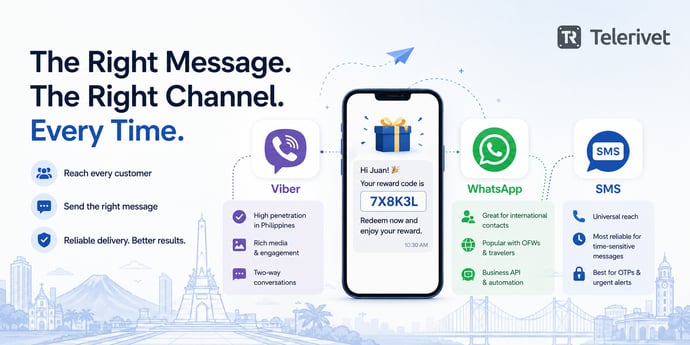
The Philippines is one of the few markets in the world where three distinct messaging channels each hold genuine relevance for business communication, with a clear hierarchy in consumer preference.
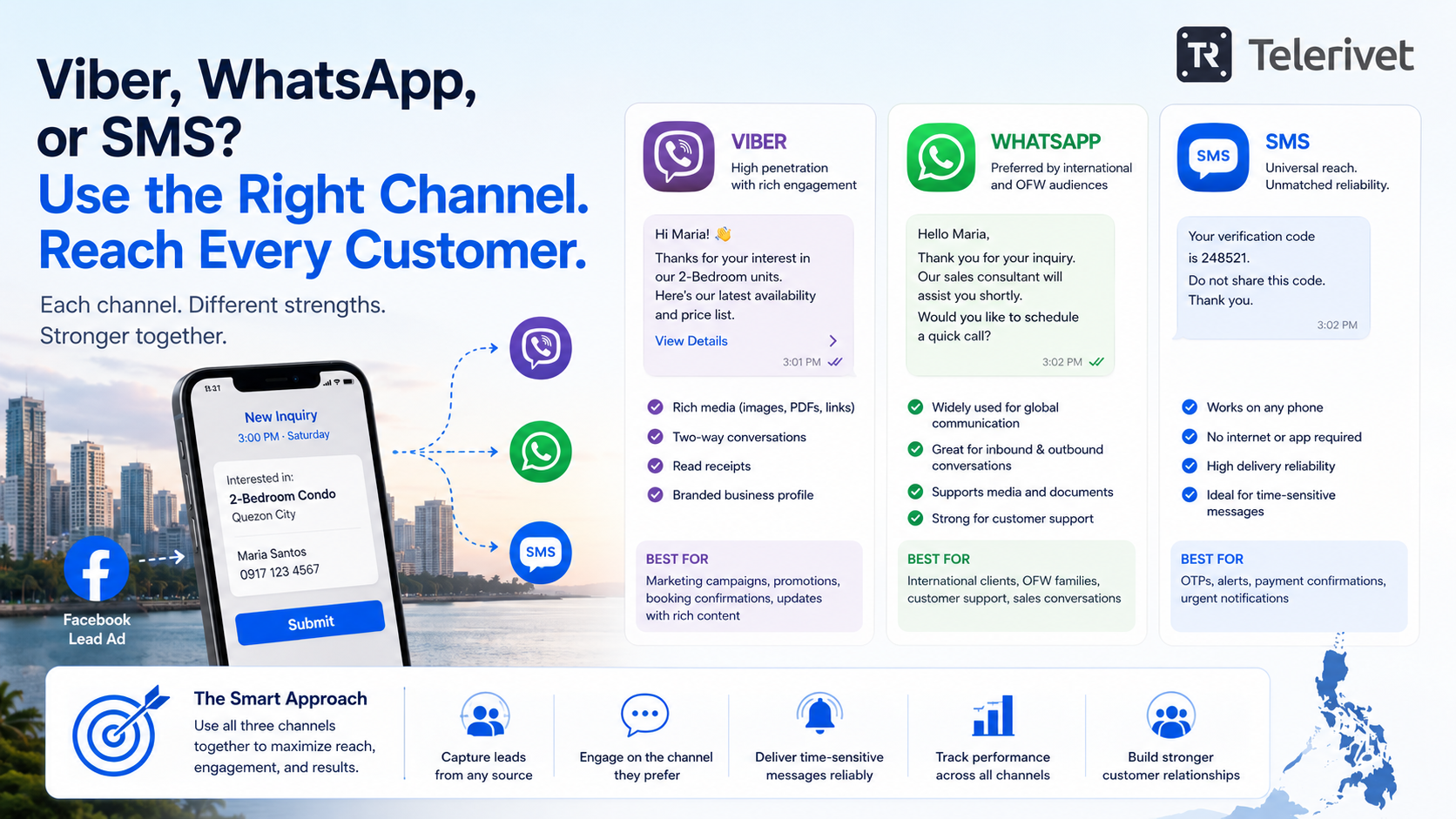
Viber has the highest penetration among Filipino smartphone users and is the default channel for everyday personal communication among domestic contacts. It supports rich media, read receipts, two-way conversation, and branded business accounts, which makes it attractive for marketing campaigns, customer engagement, and any message where you want more than delivery confirmation. Most Filipino adults of working age have it installed and check it regularly.
WhatsApp has lower overall penetration than Viber domestically, but serves a distinct audience: Filipinos with international connections, OFW families, younger urban professionals, and inbound international business contacts. In the hotel and hospitality sector, WhatsApp is the dominant channel for foreign guests. In real estate, it is often the preferred channel for buyers in the diaspora. If your customer base has an international dimension, ignoring WhatsApp means leaving that segment on a channel where your messages will arrive late or not at all.
SMS has near-universal reach. It does not require a smartphone, an app, a data connection, or the recipient to have been an existing contact. That makes it the only channel you can use to reach anyone with a Philippine mobile number, including the 30 to 40 percent of prepaid mobile users who are not active on either Viber or WhatsApp. It is also the most reliable channel for time-sensitive messages. OTPs, payment confirmations, and urgent operational alerts are still best sent via SMS in the Philippines because delivery behavior is predictable and does not depend on app state.
Viber also has a significant presence well beyond Southeast Asia. Across parts of Southeast Europe, particularly Serbia, Croatia, and Montenegro, it functions as the dominant personal messaging channel in the same way it does in the Philippines, which means businesses operating across both regions may find that their Viber account setup and workflow logic translates directly.
What Viber Does Well for Business
Viber for Business was built for markets where the app has dominant consumer penetration. The Philippines is one of the strongest examples of that. A verified Viber Business account lets you send branded, rich-media messages to your contact list with full delivery tracking and the ability to receive replies.
The practical advantages over SMS are real. You can include images, PDFs, and links without worrying about MMS carrier support. Customers can reply directly, which turns a broadcast message into a conversation thread. Delivery and read receipts give you signal that goes beyond "delivered to carrier." For marketing campaigns, loyalty program communications, and in-depth customer notifications such as a hotel sending check-in instructions with a map attachment, a clinic sending post-consultation care notes, a property developer sending a unit availability update with images. In all of these cases, Viber gives you a materially better experience for the end recipient.
There are some limitations. If your recipient has Viber but has not installed it recently, your message may arrive to an inactive app. If your recipient does not have Viber installed at all, the message does not arrive. For time-critical messages, particularly OTPs, Viber's delivery model is not a substitute for SMS. Viber Business messaging also requires a verified account and an approval process before you can send at scale.
What WhatsApp Does Well for Business
WhatsApp's enterprise capabilities are strong and have matured considerably since the API became broadly available. For businesses with international contacts, international customers, or a customer profile that skews toward younger urban demographics, WhatsApp often outperforms Viber on reach for that segment specifically.
The WhatsApp Business API supports automated messaging, template-based outbound notifications, interactive message formats, and two-way conversation routing. It handles rich media well. Its API integration options are documented and developer-friendly. For companies that want to automate responses, such as a real estate company handling initial inquiry triage or a hotel managing booking confirmations and cancellations, WhatsApp's conversational model fits naturally.
The practical gap in the Philippines is penetration outside urban centers. An FMCG company communicating with a general trade dealer network in Mindanao or the Visayas will find that WhatsApp reach drops sharply beyond Metro Manila and other major urban areas. SMS and Viber still have far more reach in provincial markets for most demographic profiles. WhatsApp also requires WhatsApp Business API access and a verified business account, which carries its own onboarding timeline and cost structure.
Why SMS Stays Non-Negotiable
The business case for SMS in 2026 is not about nostalgia. It is about physics. SMS reaches any mobile number regardless of smartphone type, app installation, data connectivity, or account status. That universality is not matched by any other channel in the Philippines market.
For use cases where delivery failure has real consequences, including authentication, payment alerts, dispatch notifications, and medical appointment reminders, SMS is the baseline that other channels sit on top of, not a fallback position you reach reluctantly. Philippine businesses that have tried to move fully to Viber or WhatsApp for operational messaging consistently rediscover this: the 20 percent of their contact base that does not have the app installed represents real people who do not get the message.
It is also worth understanding the compliance requirements that apply to business SMS in the Philippines before committing to volume. NTC sender ID registration and Data Privacy Act consent obligations apply to SMS campaigns and transactional flows alike, and getting the setup right from the start avoids disruption later.
Which Channel for Which Use Case
The channel question is really a message-type question. Different message types have different requirements for delivery reliability, richness, and two-way capability, and the right channel follows from those requirements rather than from a general platform preference.
Authentication and OTPs belong on SMS. The delivery latency requirements for a one-time password, sub-10-second delivery against a short auth window, is met most reliably by SMS because the delivery path does not depend on app state, push notification settings, or data connectivity at the moment of sending. Philippine lending companies, e-wallets, and fintechs operating at volume have largely learned this the hard way. It is also worth noting that BSP Circular 1213 is reshaping how SMS OTPs can be used for login and high-risk transactions at BSP-supervised institutions, with a June 30, 2026 compliance deadline. The compliance post covers this in full.
Marketing campaigns and customer engagement favor Viber in the domestic Philippine market. Viber's rich media support, read receipts, and high open rates make it the better choice for branded communications where response or engagement is the goal. FMCG brands running trade promotions, loyalty campaigns, or redemption workflows get more traction on Viber than SMS for this reason, though SMS remains useful as a fallback for contacts who do not receive the Viber message.
Guest and client communication with an international dimension requires WhatsApp alongside Viber. Hotels in the Philippines managing inbound international bookings, property developers communicating with diaspora buyers, and service businesses with a client base that includes non-Filipino nationals will find that WhatsApp is where those contacts actually respond. Running Viber-only for guest communications means the international segment receives nothing.
Operational and internal communications such as driver dispatch, delivery status, field agent coordination, and warehouse alerts can work on any channel where the workforce is already active. In practice, this often means SMS for provincial operations where smartphones and data are less reliable, and Viber or WhatsApp for urban-based teams with consistent smartphone access. For Philippine logistics operators, the right answer is often SMS for last-mile delivery confirmations and Viber for driver coordination in urban routes. The logistics coordination post covers this workflow in more detail.
Healthcare appointment reminders work best with a sequenced approach: SMS for the initial confirmation at booking (universal reach, delivered immediately) and Viber for the 24-hour reminder to the patients who have it, where a richer message with rebook or cancel options increases response rates.
The Multi-Channel Reality: Running All Three
Most Philippine businesses that evaluate this question carefully arrive at the same conclusion: they need all three channels, but they need a way to run them without building separate systems for each one.
The failure mode is fragmented tooling. A team that manages Viber campaigns through one dashboard, handles WhatsApp customer replies through a different tool, and sends SMS through a third vendor ends up with no unified view of what a customer has received or responded to. Messages overlap. Contacts get the same notification on three channels. Staff spend time reconciling data from disconnected platforms.
This is where a communication orchestration approach changes the operating model. When channel selection, fallback routing, and contact history live in one place, it becomes possible to build logic like: send via Viber first; if undelivered after 15 minutes, escalate to SMS. Or: send the pre-arrival message on WhatsApp for guests with international numbers, and Viber for domestic bookings. The channel strategy framing here explains the underlying architecture, and the fallback routing post covers how escalation sequences work in practice.
For hospitality specifically, the combination of Viber for domestic guests, WhatsApp for international guests, and SMS as a universal fallback is the pattern that fits the Philippine market.
The same logic applies to any vertical where the contact base is not homogeneous: FMCG dealer networks spanning urban and provincial markets, healthcare networks serving patients across income levels, financial services reaching both smartphone and feature phone users. The channel mix is not a luxury: it is a function of who you are actually trying to reach.
Getting Started with Viber Business in the Philippines
Viber Business messaging in the Philippines goes through a verification and onboarding process before you can send at scale. For Philippine businesses, the core documents you will need to prepare are:
- A completed business information sheet for Viber account creation
- SEC Registration (Securities and Exchange Commission)
- BIR Registration (Bureau of Internal Revenue)
- A General Information Sheet (GIS) to verify beneficial ownership
- Logo assets in multiple sizes for your business profile and banner (your provider will confirm the current specifications during onboarding)
The logo requirement catches teams off guard if they are not prepared for it. Equivalent business registration documents apply in other markets; the specific document names vary by jurisdiction but the verification intent is the same.
WhatsApp Business API and SMS sender ID registration each have their own onboarding requirements. Philippine SMS sender ID registration runs through NTC and carries a lead time that is worth accounting for in your launch timeline.
Frequently Asked Questions
Is Viber or WhatsApp more popular in the Philippines? Viber has higher penetration among Filipino domestic users and is the default personal messaging app for most of the population. WhatsApp has growing use among younger urban professionals and Filipinos with international connections, but Viber leads for general domestic reach.
Can I use Viber for OTP delivery in the Philippines? Viber can be used for OTP delivery, but SMS is more reliable for authentication use cases. OTP windows are typically 30 to 60 seconds, and SMS delivery latency in the Philippines is more predictable than app-dependent channels. Most Philippine fintechs and lenders use SMS as their primary OTP channel.
Do I need a verified business account to send Viber messages at scale? Yes. Viber Business requires account verification before you can send branded messages to contacts who have not added you. The verification process involves business registration documents and a Viber-specific business profile setup. This is different from regular personal Viber use.
What is the best channel for reaching provincial markets in the Philippines? SMS has the most reliable reach in provincial and rural areas where smartphone penetration and data connectivity are less consistent. Viber can work well in provincial cities and large towns where smartphone use is high, but SMS should be included in the workflow as a fallback for any campaign targeting a nationwide audience.
Can one platform send on Viber, WhatsApp, and SMS at the same time? Yes. Platforms like Telerivet let you manage Viber, WhatsApp, and SMS from a single account, design fallback sequences between channels, and see delivery and response data in one place. This removes the operational cost of managing separate tools for each channel.
Does Viber work for business messaging outside the Philippines? Yes. Viber has strong penetration across several markets in Southeast Asia and significant reach in parts of Southeast Europe, particularly Serbia, Croatia, and Montenegro, where it functions similarly to how it does in the Philippines. Businesses operating across multiple Viber-strong markets can use the same account setup and workflow logic across regions.
Do I need to register a sender ID for Viber and SMS in the Philippines? For SMS, yes. Sender ID registration runs through Globe, Smart, and DITO in coordination with your provider, and Philippine carriers classify sender IDs as either domestic (for locally registered businesses) or international/Premium A2P (for companies headquartered outside the Philippines), with different documentation requirements for each. Viber Business requires a separate account verification process through Viber's business onboarding. Both carry lead times that are worth accounting for before your planned go-live date. The Telerivet team can help you procure and manage both.
Ready to run Viber, WhatsApp, and SMS from one place? If you'd like to discuss how to build your channel mix for the Philippine market:
