Hotel guest messaging refers to the automated and manual communication between a property and its guests across channels including WhatsApp, Viber, SMS, Instagram, Facebook Messenger. Effective hotel guest messaging connects these channels to a shared workflow layer so that booking events, modifications, and guest requests trigger coordinated communication across staff and guests simultaneously, rather than being handled manually on separate devices..
A guest confirms a booking. That single event immediately needs to reach three different people: the guest themselves, the reservations coordinator, and housekeeping. Three messages. Three audiences. One trigger.
In most hotels, those three messages come from three different places. The guest gets a confirmation from whatever channel the booking came through. The reservations team gets a Viber message from the front desk. Housekeeping gets a note in a WhatsApp group. No single system knows all three happened. No single system knows if any of them failed.
This is the hotel guest messaging problem, and it has nothing to do with which channels a property is using. It has everything to do with the fact that the channels are not connected to each other or to the event that triggered them.
The Channels Arrived One at a Time
Most hotel operators in Southeast Asia, East Africa and beyond did not design their current messaging setup. They accumulated it. Messenger came first because guests started using it for inquiries. WhatsApp arrived because it became impossible to avoid. Viber stayed on because a meaningful share of the local market prefers it, particularly in the Philippines and parts of Indonesia where Viber penetration is high enough that ignoring it means ignoring a real slice of incoming guests. SMS stuck around because it reaches guests who are not on any of the above, and because it still works when apps do not.
Each channel solved a real problem when it arrived. The result, several years later, is a front desk team splitting attention between a phone, a shared tablet, and a personal device that nobody officially sanctioned, manually routing messages that should have been routing themselves. This is one of the most common ways multichannel customer experience breaks down in practice, not because operators made poor choices, but because each channel decision looked reasonable in isolation.
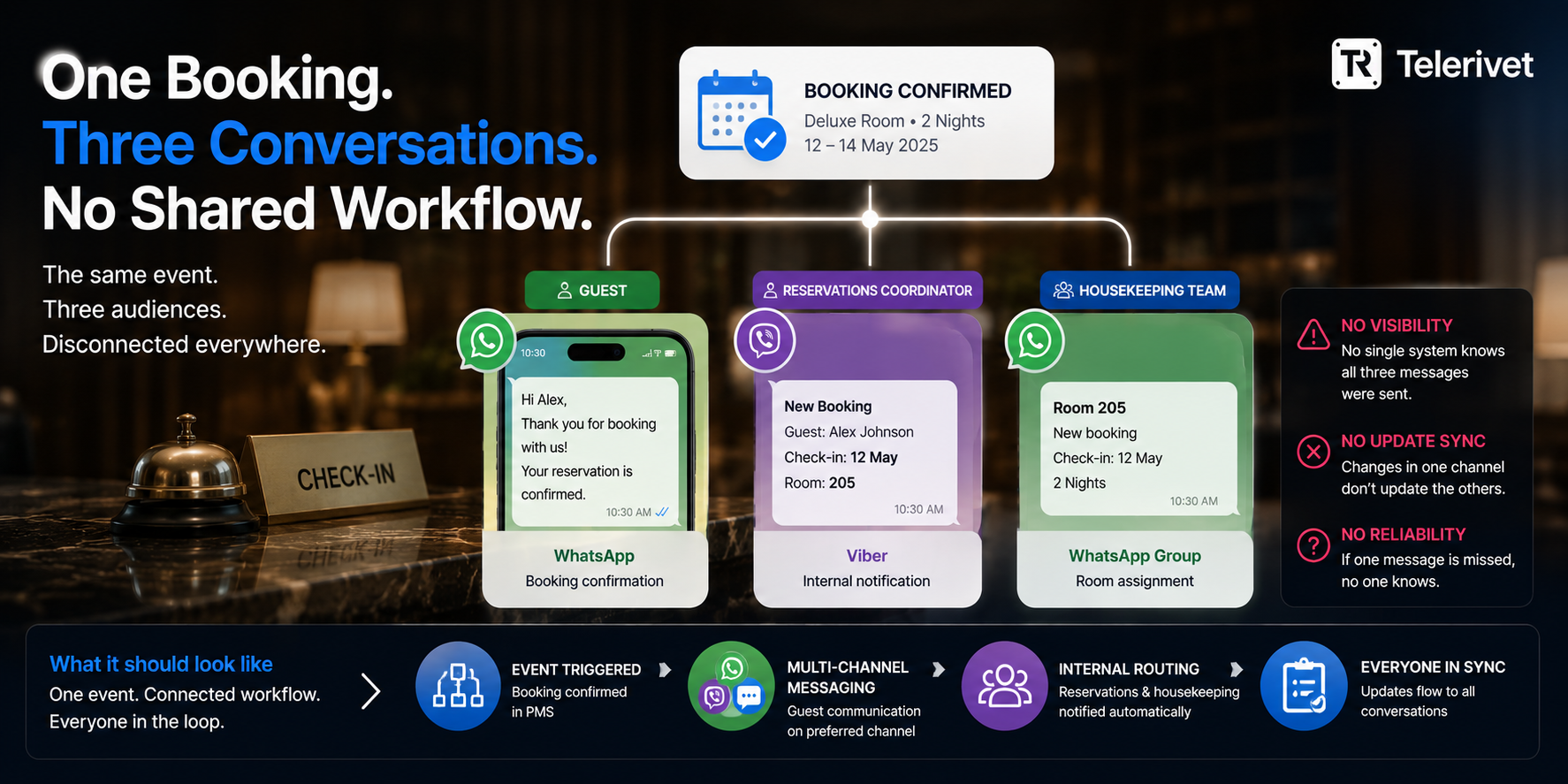
One Event. Three Conversations. No Shared Workflow.
When the booking confirmation is the clearest example of the problem, it is worth tracing it in full.
A guest books a room. The front desk sends a confirmation via WhatsApp because that is what the guest used to inquire. The reservations coordinator gets told via Viber. Housekeeping gets updated in a separate group chat. Three conversations have now started from one event, and none of them knows the others exist.
The guest calls the next day to modify their arrival time. The front desk updates the Viber thread with the reservations coordinator. The WhatsApp confirmation the guest received does not change. The housekeeping group chat does not get updated until someone remembers to do it. Whether someone remembers depends entirely on how busy that shift is.
The modification gets missed. The room is not ready at the new arrival time. The guest's first impression of the property is formed by a failure that had nothing to do with the room itself.
This coordination gap is not unique to hospitality. The same pattern appears in logistics operations where drivers, dispatchers, and customers all need information from the same event but receive it through separate channels with no shared logic. The failure mode is identical: someone has to manually translate an event into messages for multiple audiences, and that translation step is where things get missed under load.
Messaging Is Not Another System
The instinct when hospitality operators start solving this problem is to evaluate messaging platforms as another system to add to the stack alongside the PMS, the booking engine, the OTA connections, the housekeeping tool, and the CRM.
That framing is the mistake. Messaging is not another system. It is the connective layer between the systems that already exist. When a booking status changes in the PMS, messaging is what tells the guest and the housekeeping team simultaneously. When an OTA confirms a reservation, messaging is what turns that data event into a personalized pre-arrival conversation with the guest on whichever channel they actually use. When a complaint is logged, messaging is what routes it internally and closes the loop with the guest when it is resolved.
This is the hidden layer in most communication operations: the routing logic, the trigger conditions, the channel sequencing that should sit between a system of record and the people who need to act on it. When that layer does not exist, people become the routing layer. And people, unlike workflows, have shifts, competing priorities, and limited memory.
A messaging layer that sits alongside other systems without connecting to them adds another inbox to manage. A messaging layer that connects to the events those systems generate turns every status change into a coordinated, multi-audience communication without anyone on the front desk having to initiate it.
🗓️ Schedule a Meeting to Learn How Telerivet Fits Your Business Needs
The Viber Problem Is Worth Naming Specifically
In Southeast Asian markets, particularly the Philippines, the channel consolidation problem has a specific wrinkle that most guest messaging platforms do not address. Many hotel properties already have a Viber Business presence. What they do not have is an API connection to it, meaning every Viber conversation is still handled manually from a shared device. The account exists. The audience is there. The workflow is not.
Connecting an existing Viber Business ID to a workflow layer that handles routing, automation, and coordination alongside WhatsApp and SMS does not require building something new. It requires connecting what is already there to the event logic that should have been driving it from the start.
In East African markets, the parallel problem takes a different form. Guesthouse and boutique hotel operators in Kenya and neighboring countries frequently run their entire reservation and guest communication workflow through a personal WhatsApp number. It works at low volume. It becomes a single point of failure the moment that staff member leaves, and it offers no routing logic, no automation, and no record of what was promised to whom.
The underlying issue in both cases is the same: channels that are live and active, attached to nothing that coordinates them.
What Changes When the Workflow Connects
When a booking event triggers guest messaging, internal routing, and housekeeping notification from the same workflow layer, three things happen that do not happen when each channel is managed separately.
First, the messages are consistent. The guest, the reservations team, and housekeeping all receive information derived from the same source at the same moment. Modifications propagate. Cancellations reach everyone.
Second, the front desk is no longer the router. Staff are not manually translating guest events into internal actions and back again. That translation step, the one where things get missed during a busy check-in period, is handled by the workflow.
Third, the post-stay feedback loop closes automatically. A departure date triggers a message. The guest receives it on whatever channel they used during their stay. The property gets a response it can act on, rather than a review it discovers two weeks later on a platform it does not control.
None of this requires replacing the PMS or the booking engine. It requires connecting them to a messaging layer with the routing logic to handle which channel reaches which audience when. That layer was always supposed to be there. In most hotels, it has just never been built.
Frequently Asked Questions
Why do hotels use multiple messaging channels like WhatsApp, Viber, and SMS?
Different guest segments use different apps. In Asia, WhatsApp and Viber both carry significant user bases, particularly in the Philippines and Indonesia. SMS remains essential as a fallback for guests without reliable data access or those who do not use chat apps. Hotels use multiple channels because no single channel reaches every guest reliably.
What is the difference between managing hotel messaging channels separately versus using a shared workflow?
Managing channels separately means each channel operates on a different device or account with no shared history, no coordinated routing, and no automated triggers. A shared workflow layer connects all channels to the same booking events, so a reservation change updates the guest, the reservations team, and housekeeping simultaneously without manual translation by front desk staff.
How does a hotel unified messaging inbox work?
A unified inbox aggregates incoming and outgoing messages from WhatsApp, Viber, SMS, Messenger into a single interface. Agents see the full conversation history regardless of which channel the guest used, and outbound messages can be routed to the guest's preferred channel automatically.
Which messaging channel should hotels use as a fallback?
SMS is the standard fallback for hotel guest messaging because it does not require an app installation or an active data connection. A hotel messaging workflow that attempts WhatsApp or Viber delivery first and falls back to SMS on non-delivery reaches the full guest population regardless of device or connectivity.
Telerivet supports multi-channel hotel guest communication across WhatsApp, Viber, and SMS from a single workflow layer, including Viber Business API connectivity for properties with existing Viber accounts. See how Telerivet handles multi-channel guest communication.
