Automotive and EV brands in markets across Southeast Asia, South Asia, and Africa use WhatsApp and SMS to manage communication across a customer journey that spans months: from initial inquiry through test drive, purchase, delivery, and ongoing ownership. The communication requirement at each stage is different, lead qualification looks nothing like service reminders, and the channel mix shifts depending on where the customer is in the journey and what device and connectivity environment they are in.
Selling a car is not a single transaction. It is a relationship that starts months before a customer makes a decision and continues long after they drive away. And at each stage of that journey, the communication requirement is completely different..
What makes automotive and EV brands in emerging markets interesting is that this entire arc happens on SMS, WhatsApp, Viber etc. Not email. Not an app. The channels customers are already using every day, on the phones they already have. The brands building serious customer relationships in these markets are not running a single channel or a single campaign. They are running distinct workflows at each stage of the journey, matched to what the customer actually needs at that moment.
Here is what those four stages look like in practice.
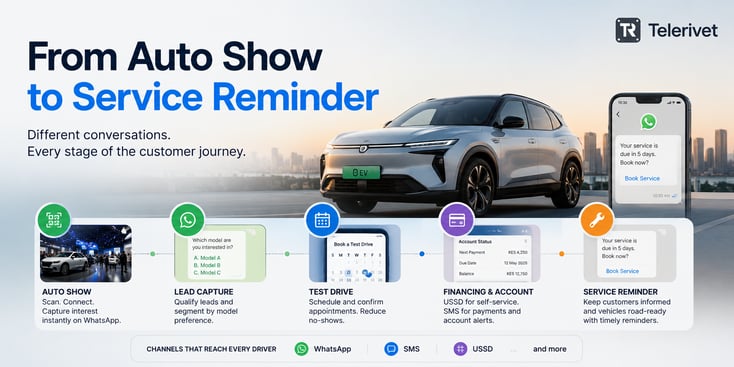
Stage One: Capturing and Qualifying Leads at Events
Auto shows remain one of the primary venues where buyers in emerging markets encounter new models for the first time. The challenge is converting a moment of in-person interest into an ongoing relationship before the customer walks out of the hall and the moment passes.
An EV distributor in Asia running multiple international brands built a WhatsApp-based lead capture system for their national auto show. Visitors scanned a QR code displayed at the brand stand, which opened an automated WhatsApp conversation. The conversation asked for the customer's name, presented a menu of four EV models and prompted a selection, then entered the customer into a prize draw tied to completing their registration. The whole exchange took under two minutes.
They had an 88 percent completion rate on a voluntary, self-serve registration flow run entirely on WhatsApp. The contacts captured were automatically segmented by model preference, with follow-up sequences specific to the vehicle they expressed interest in. Newsletter subscriptions and quiz engagement ran through the same channel in the days following the show.
The design decision that made this work was treating WhatsApp as a two-way registration system rather than a broadcast tool. The conversation captured preference data at the same moment as the contact detail, without a separate form or a sales rep manually recording responses at a busy stand.
Stage Two: Financing and Account Management
Not every automotive sale is a single upfront payment. EV motorcycles and entry-level vehicles sold on installment financing require ongoing communication about account status, payment balances, and top-up options. That communication needs to work for customers who may not have a smartphone or reliable data access.
An EV motorcycle financing operator in Kenya built their entire customer-facing account management system on USSD, the channel that functions on any phone, with any carrier, without a data connection. Customers dial a short code to check their balance, initiate a payment through M-Pesa, retrieve a referral code, or reach support. The session logic handles state management, validates the phone number, and routes the request to the operator's backend in real time.
On a typical day, the system handles hundreds of USSD sessions and sends thousands of outbound SMS notifications. The two channels serve different purposes: USSD is the customer's self-service interface, SMS is the outbound notification layer for payment confirmations, account status changes, and service alerts. For a financing operator with no branch network, this combination replaces the in-person service touchpoint entirely. For more on how SMS routing works in markets like this, see our piece on deploying SMS across multiple networks.
The PAYGo model pioneered in solar energy has shown how durable this pattern is at scale. Financing operators in energy access markets have been running payment communication on SMS and USSD for years. EV mobility is following the same path.
Stage Three: Post-Purchase Engagement and Service Reminders
The period immediately after purchase is when most automotive communication goes quiet. The sale is done, the sales team has moved on, and the service department is not relevant yet. This gap is exactly where a well-timed message builds the kind of relationship that produces a return visit rather than a lost customer.
An automobile distributor in India runs a post-purchase sequence for one of their brands. The trigger is time-based: a set period after the customer takes ownership, they receive a personalized message referencing how long they have owned their specific model. Customers who reply receive their next service date, vehicle identification number, and service hotline automatically, pulled from the contact record.
This is not a broadcast. It reads like a message from a brand that knows the customer, because the data behind it - ownership duration, model name, etc is specific to that person. The service hotline is included so the response is immediately actionable.
Alongside these sequences, the brand runs warranty broadcast campaigns: a single message to their customer base with specific warranty terms for battery and motor, links to documentation, and a WhatsApp number for follow-up questions. Link clicks are tracked, and customers who click but do not start a conversation are added to a follow-up group for a second touchpoint within minutes.
Stage Four: Re-engagement and Upgrade Campaigns
A customer who bought an entry-level vehicle a few years ago is a warm prospect for a new model launch. The channel and timing of the outreach determines whether that message lands or goes ignored.
The distributor's re-engagement campaigns run on both WhatsApp and SMS, with channel fallback built into the workflow logic. Customers receive a WhatsApp message first. If the link in that message gets clicked but the customer does not initiate a conversation, an automated trigger fires an SMS within two minutes carrying the same offer. Customers who engage through SMS are then routed to a WhatsApp number for the follow-up conversation.
This is not a second attempt at the same thing. It is a recognition that channel preference varies by customer and time of day, and that the message is important enough to find the customer through whichever route works. Across the campaigns, the channel split was about 80% WhatsApp and 20% SMS. Building for only one of those channels means missing roughly one in five customers at any given moment.
Why the Channel Mix Matters
The automotive customer journey in an emerging market requires at least three different channel strategies operating in sequence: a conversational two-way flow for lead capture, a structured self-service interface for financing and account management, and a triggered notification system for post-purchase engagement. Each stage has different latency requirements, different response expectations, and a different profile of which customers are reachable on which channel.
Getting this right is not about choosing a single platform and broadcasting at scale. It is about matching the channel to the moment across a journey that spans months and involves customers with very different device and connectivity profiles. The brands doing this well are building communication workflows that look different at the auto show, at the point of first payment, at the first service interval, and at the moment a new model launches. What ties them together is not the channel. It is the customer record that persists across all four.
For a deeper look at how channel completeness works across markets with varying connectivity, see our piece on what it means to reach every customer regardless of device.
Frequently Asked Questions
How do automotive brands use WhatsApp for lead management? The most common pattern is using WhatsApp as the inbound channel for test drive inquiries and product questions, with an automated routing workflow that qualifies the lead and assigns it to the right dealership or sales representative. WhatsApp is well-suited for this because it supports images (customers can share the model they are interested in), voice notes, and document sharing (for financing pre-qualification), and because in most Southeast Asian and South Asian markets, it is the primary messaging channel for customer-to-business communication.
What is the role of SMS in the automotive customer journey? SMS handles the parts of the journey where reliability matters more than richness: appointment confirmations, service reminders, payment due dates, and delivery notifications. It also serves as the fallback channel for customers who are not on WhatsApp or who have patchy data access. In markets where the customer base spans both smartphone users and feature phone users, SMS is often the lowest-common-denominator channel that reaches everyone, while WhatsApp handles the richer interactions for the segment that supports it.
How do EV brands use messaging differently from traditional automotive brands? EV brands typically have a longer and more education-intensive pre-purchase journey, customers need information about range, charging, incentives, and financing that does not apply to traditional vehicles. Messaging workflows for EV brands often include multi-step educational sequences delivered over several weeks, with interactive elements allowing customers to request specific information or connect with a specialist. Post-purchase, EV brands also have ongoing communication needs around charging behavior, software updates, and range optimization that create more sustained engagement than traditional service intervals.
What does a post-purchase automotive communication workflow look like? A post-purchase workflow typically covers: delivery confirmation and vehicle handover, initial ownership check-in (at 30 and 90 days), first service reminder (at 6-12 months depending on mileage), and ongoing service interval reminders. For EV brands, it also includes charging optimization tips and software update notifications. The workflow runs from the delivery date, without manual scheduling at each step. Two-way handling allows owners to book service appointments by replying to a reminder, rather than calling the dealership.
Telerivet supports automotive and EV operators running multi-stage customer communication across WhatsApp, SMS, and USSD.
