There is a specific moment when a lending operation discovers the ceiling of its messaging setup. It is not a deliverability failure. The reminders go out on time, at volume, month after month. The moment comes when a borrower replies to one of those reminders and nothing happens, because nothing was ever built to happen. We are seeing this play out right now with high-volume lenders sending millions of messages a month through providers they are otherwise satisfied with. They are not leaving because messages fail to arrive. They are leaving because the conversation only goes one direction.
Two-way collections messaging is a workflow design in which every outbound payment reminder can receive, interpret, and act on a borrower's reply automatically: logging a payment claim, confirming receipt, routing a question to an agent, or advancing the account to the next escalation step. The reminder is the easy part. What happens after the reply is where collections outcomes actually change.
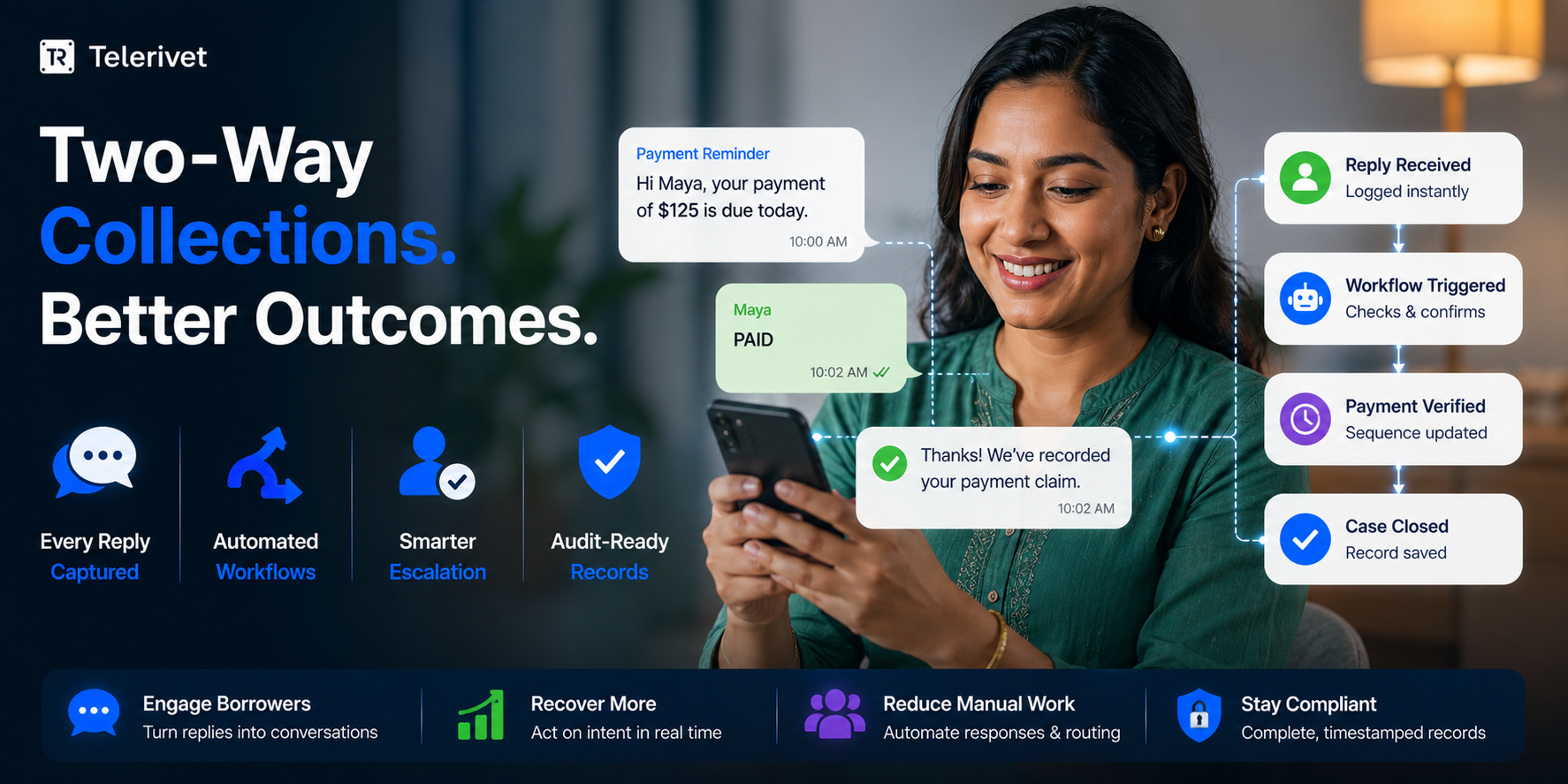
The One-Way Ceiling
Most fintech messaging content treats the payment reminder itself as the workflow. Schedule it, personalize it, send it before the due date. That is table stakes, and if it is all your setup can do, every reply your reminders generate becomes invisible work. Borrowers answer reminders. They say they already paid. They ask for three more days. They ask what the balance is. They dispute the amount. In a one-way setup, those replies either land in an inbox nobody owns or bounce off a number that cannot receive at all.
The operational cost is real, but the strategic cost is bigger. Every one of those replies is a borrower engaging with their own debt at the moment of maximum attention. A one-way system throws that moment away.
The PAID Loop
Consider the single most common reply a payment reminder gets: some version of "I already paid." In a one-way system this is a dead end that quietly erodes trust, because the borrower keeps getting reminders for a debt they believe is settled.
In a two-way workflow, that reply becomes a structured event. A borrower replies PAID. The workflow logs the claim against their account with a timestamp, sends an immediate acknowledgment so the borrower knows they were heard, and pauses the reminder sequence for that account. It then checks whether a payment actually posts. If the payment is reflected within the verification window, the sequence closes with a confirmation message. If it is not reflected within 24 hours, the account is flagged for an agent to review, with the full message history attached. Borrowers frequently attach evidence rather than just replying with the keyword, a screenshot of a bank transfer or a photo of a receipt. A workflow that only parses text misses this. Accepting inbound images and attaching them to the flagged account turns a dispute into something the agent can verify at a glance instead of a back and forth asking the borrower to resend proof.
That is a materially different process from sending a reminder and waiting. The borrower gets agency and an instant response. The lender gets a clean queue of genuine discrepancies instead of an inbox of unread replies, and each of those discrepancies is exactly the failure mode covered in our post on payments that arrive while accounts fail to update. The acknowledgment loop and the reconciliation workflow are two halves of the same system.
Escalation Is a Sequence Design Problem
The second thing two-way capability changes is escalation. Most lenders already escalate informally: the messages get more insistent as the account ages. Designing it deliberately means treating tone, timing, and channel as variables in a sequence rather than improvisations.
A working pattern looks like this. On day one past due, a friendly reminder that assumes good faith and includes the amount and payment instructions. If there is no payment and no reply by day seven, a firmer message that names the consequence of continued non-payment in plain language and offers a reply keyword to request a callback or a payment plan. By day fourteen, the tone changes again and so does the method: a different channel, a voice call, or routing to a human agent, because a borrower who has ignored two messages on one channel is unlikely to respond to a third on the same one.
The critical design detail is that replies interrupt the sequence at any point. A borrower who responds PAID, or asks a question, or requests more time is no longer in the drip. They are in a conversation, and handling that conversation well is what separates collections that recover relationships from collections that burn them. Grace period logic belongs here too: the sequence should know the difference between one day late and one payment cycle late, and borrowers inside a contractual grace period should never receive escalation-tier messaging. Channel choice adds a compliance layer that a text-only reminder does not have. WhatsApp requires reminder and settlement-offer messages to run through pre-approved templates, and getting a template rejected mid-sequence stalls the whole cadence. The practical fix is treating template approval as part of sequence design rather than an afterthought: submit the day-one reminder, the day-seven firm notice, and the settlement-offer variant for approval together, before the sequence goes live, so a stalled approval does not leave an account stuck mid-escalation.
Getting There Without Replacing What Works
The lenders making this move at scale are rarely rebuilding their stack. Their loan management systems are in-house, already generating the events that matter: due dates approaching, payments posting, accounts aging. What they add is a workflow layer those systems can trigger by API, one that handles the sending, the reply interpretation, the sequence state, and the agent handoff. That layer can run alongside an existing provider during migration, which matters when you are moving seven-digit monthly volumes and cannot tolerate a gap. It also consolidates the surrounding message types, from OTPs and transactional notices to the broader customer communication patterns covered in our fintech and mobile money pillar, onto the same rails as collections.
Frequently Asked Questions
What replies should a collections workflow recognize automatically? Start with a small set: a payment claim keyword like PAID, a callback or help request, and a request for more time. Everything else routes to a shared inbox or agent queue with the account context attached. A workflow that handles three structured intents well beats one that attempts twenty and misfires.
What happens when a borrower says they paid but the payment does not show? The claim is logged, reminders pause, and the account is flagged for verification if no payment posts within a defined window, typically 24 hours. The agent who picks it up sees the claim, the timestamp, and the message history, which turns an argument into a lookup.
Does escalation mean sending more messages? No. It means sending different messages. Frequency stays modest while tone, content, and eventually channel change as the account ages. Volume without progression trains borrowers to ignore you and increases complaint risk.
Can this work alongside our current messaging provider? Yes. The two-way workflow layer can run in parallel during a transition, taking over reply handling and escalation sequences while existing routes continue to carry volume. That avoids a cutover risk on a live collections operation.
Does WhatsApp allow payment reminder and settlement messages? Yes, but they have to run as pre-approved message templates rather than free-form text. Meta reviews reminder, notice, and settlement-offer templates before they can send, so the templates for every stage of your escalation sequence need approval before the sequence goes live, not mid-cadence. Build template submission into your rollout timeline the same way you would any other compliance step.
Can borrowers send proof of payment through the same channel? Yes, if the channel and workflow support inbound attachments. A borrower disputing a reminder will often send a screenshot or photo of a receipt rather than typing a reply. That image should attach to the flagged account automatically so the agent reviewing it has the evidence in front of them instead of having to ask the borrower to resend it elsewhere.
If your reminders are going out but the replies have nowhere to go, that is the gap worth closing first. Talk to us about connecting your loan management system to a two-way collections workflow.