Every SMS gateway operator and regional aggregator is having the same conversation with their enterprise clients right now. The client wants WhatsApp. They want to send order confirmations, run customer service, push payment reminders, and do it through the channel their customers actually have open. The operator has built a reliable SMS operation over years of carrier relationship work. But if the customer also asks for WhatsApp, they have nothing to offer..
For SMS gateway operators and aggregators, the WhatsApp gap is not a channel preference problem. It is an access problem. Offering WhatsApp as a business communication channel requires Meta Business Partner status or a formal arrangement with a registered Business Solution Provider. Most local operators and regional aggregators have neither, and the path to obtaining either independently is not straightforward.
That access gap is costing operators more than a single channel. It is costing them enterprise client relationships they built before WhatsApp existed.
Why the Access Wall Is Real
WhatsApp's business messaging architecture is not open. A business cannot simply connect to the WhatsApp API the way it connects to an SMS gateway. Access requires approval through Meta's partner program, compliance with Meta's business policy, ongoing template management, and a technical integration that meets Meta's verification standards.
For a local SMS gateway operation, navigating that process alone is a significant resource commitment. For a regional aggregator serving clients across multiple markets, the compliance overhead multiplies. Most operators who have looked into it have either stalled in the approval process or concluded that the path runs through a platform partner who already has the relationship in place.
That is the practical reality. And it explains why so many gateway operators end up pointing enterprise clients toward third-party CPaaS platforms to get WhatsApp set up, which is the same dynamic described in the broader platform gap for this tier: the operator handles SMS delivery while the platform owns the client's digital communication relationship.
What Native Access Actually Unlocks
When a gateway operator or aggregator can offer WhatsApp natively through a platform partnership, the commercial conversation with enterprise clients changes materially. WhatsApp is not just a channel with higher open rates. It is a two-way communication environment with a fundamentally different operational model than SMS broadcast.
User-initiated WhatsApp conversations open a 24-hour service window in which the business can respond with rich content, automated workflows, and human handoff logic without the template restrictions that apply to business-initiated messages. For the enterprise clients asking for WhatsApp, this is not about switching from SMS. It is about adding a layer that SMS cannot replicate: the catalog, the quick reply, the automated intake flow that routes to the right team, the appointment confirmation that the client can respond to directly.
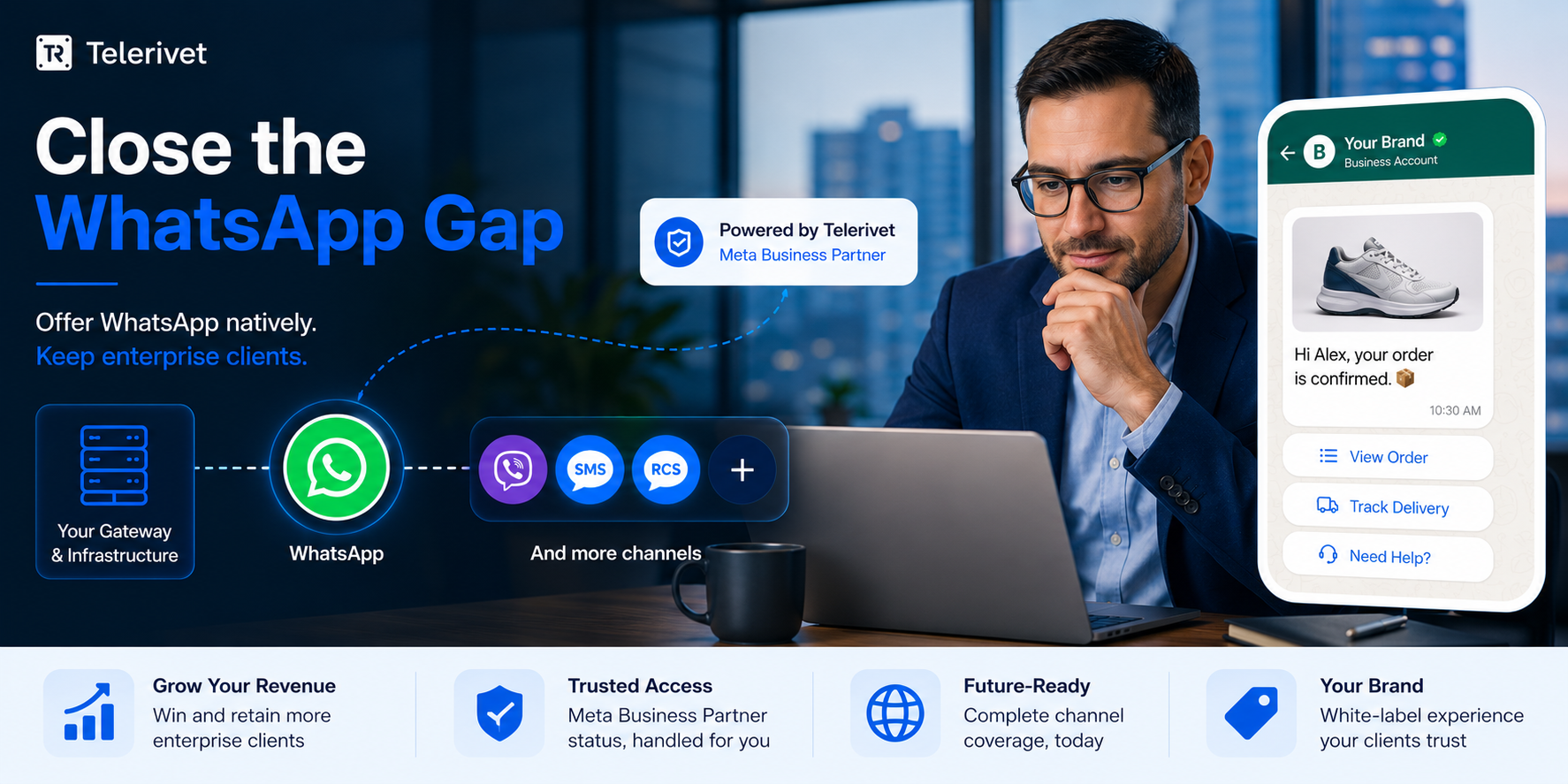
Telerivet holds official Meta Business Partner status covering WhatsApp, Instagram Messenger, and Facebook Messenger. For a gateway operator or aggregator partnering through Telerivet's platform, that Meta relationship is already in place. The operator does not navigate the approval process independently. WhatsApp access is surfaced through the platform partnership without the operator managing the BSP compliance layer themselves.
The Channel After WhatsApp
Operators who have been in the messaging business for more than a decade have already lived through one major channel shift. They built on SMS. WhatsApp arrived and they had nothing. The ones who are moving now to close the WhatsApp gap are making the right call, but WhatsApp is not the endpoint.
Viber holds significant market share across Southeast Asia, Eastern Europe, and parts of the Middle East. RCS is gaining traction in markets where mobile network operators are actively promoting it. And in an environment where AI is accelerating product development cycles, the timeline between a new communication application gaining consumer adoption and enterprise clients asking for it is compressing. The operators who close the WhatsApp gap by adding a single channel will be better positioned than they are today. The operators who close it by adding a platform layer will not be having this conversation again in three years.
Connectivity needs to be complete, not limited to whatever channel is dominant at the moment. Telerivet's connectivity completeness architecture is built around that principle: the platform supports the full channel set so that when client demand shifts, the operator's product offer moves with it rather than behind it. For a practical view of how channel selection works across a live client base, the Telerivet channel guide covers the decision logic across SMS, WhatsApp, Viber, and other supported channels in plain terms.
You Have a Backup Channel. That's Not the Same as a Channel Strategy. covers the operational difference between having channel options and running them as a coordinated program. That coordination layer is where communication orchestration becomes relevant for operators thinking about what they are actually selling to enterprise clients: not a collection of separate channel setups, but a single platform that manages the logic across all of them.
Frequently Asked Questions
Does offering WhatsApp through a platform partnership require rebuilding our SMS setup? No. Existing SMS routes and carrier connections remain in place. WhatsApp and additional channels are added above them through the platform layer. The operator's existing message delivery capability is preserved and extended.
Can we offer WhatsApp under our own brand? Yes. A white-label deployment means the platform runs under the operator's brand. Enterprise clients interact with a product that looks like the operator's own offering. The Meta Business Partner relationship operates at the platform level, not the operator's brand level.
What happens when a client wants a channel we have not set up yet? That is precisely the case for a connectivity-complete platform model. Adding a new channel does not require renegotiating the platform partnership or rebuilding the client's workflow setup. The channel is added at the platform level and becomes available to all clients operating on it.
For organizations already using WhatsApp at enterprise scale, WhatsApp for Enterprise covers how communication programs are built and managed across large client bases. To see how Telerivet works specifically for networks and aggregators, start with the solutions page, or contact the Telerivet team to talk through your operation directly.
