Running an SMS vaccination reminder program at scale requires four components working together: a reliable patient contact list with valid numbers and language preferences, a messaging platform capable of multi-language sequencing and two-way response handling, integration with the health facility's scheduling or registry system, and routing logic that accounts for recipients without smartphones or reliable data access. The communication problem is solvable. The operational challenge is building the workflow that connects all four.
Vaccination coverage gaps in low- and middle-income countries are not always caused by vaccine shortages. In many programs, vaccines are available, health facilities are operating, and community health workers are already deployed..
The breakdown often happens at the last communication step.
Families may not know when a child's next dose is due. They may forget the appointment. They may assume someone else will remind them. SMS vaccination reminders address that gap directly by sending timely, personalised messages before a scheduled dose is missed.
The evidence for reminder programs is strong. The operational reality is more complicated.
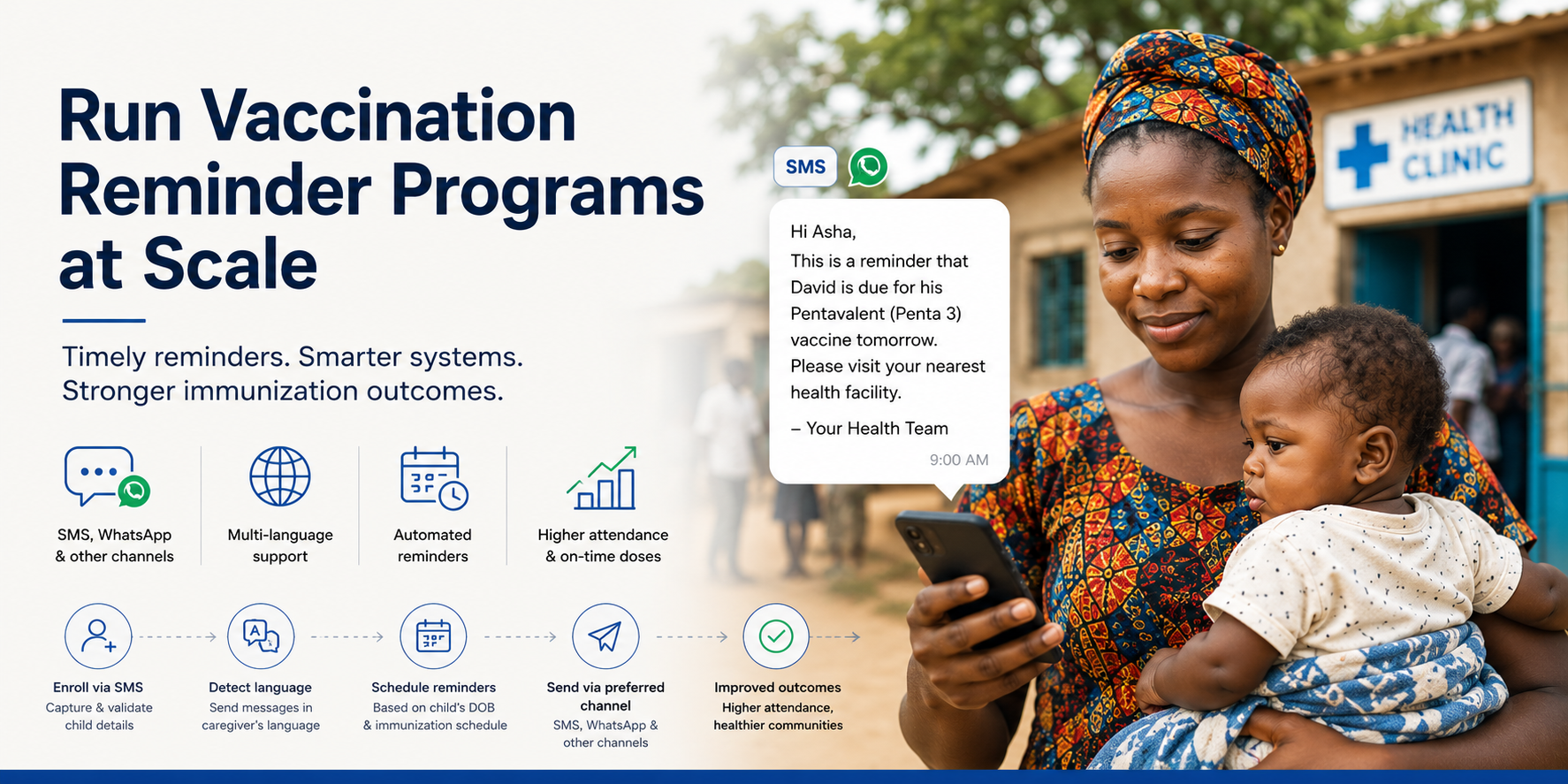
What "Sending Reminders" Actually Involves
The simplest SMS reminder is a broadcast: send the same message to everyone on a list.
That can work for a one-time campaign. It does not work for a program that needs to run continuously across thousands or millions of enrolled contacts, over multiple years, in places where network coverage varies, caregivers speak different languages, and some messages will fail to deliver.
At scale, vaccination reminder programs depend on several operational capabilities working together.
Enrollment at the Point of Contact
In communities with low smartphone penetration, SMS enrollment is often the most practical way to reach caregivers.
A caregiver can text a keyword, a child's name, and a date of birth. The system validates the date, detects or captures the language, assigns the contact to the right reminder sequence, and confirms enrollment automatically.
That matters because enrollment through a web form or app can exclude the very families most likely to miss a vaccination.
Per-Contact Timing, Not Fixed Campaign Sends
Vaccination reminders need to follow each child's schedule, not a program-wide send date.
A child's date of birth, the national immunization calendar, and the next due vaccine all need to determine when reminders are sent. That is different from sending a campaign to a group on a fixed date.
When programs treat personalised reminders like ordinary broadcasts, they risk sending irrelevant messages, missing critical windows, or creating confusion for caregivers.
Language Handling as Core Infrastructure
In multilingual deployments, language cannot be treated as a nice-to-have.
If a caregiver enrolls in one language, the reminder sequence should continue in that language. Message templates, confirmations, opt-out instructions, and follow-ups all need to reflect the caregiver's preference.
Without language-specific workflows, a program may generate high send volumes without creating real understanding or action.
Automated Failure Recovery
In low-connectivity environments, delivery failures are expected.
A reminder system that sends once and moves on will miss a portion of its audience every cycle. programs need automated failure detection, resend logic, and alternative message wording so retries do not look like accidental duplicates.
This is not an advanced feature. It is a reliability requirement.
Channel Redundancy Where It Makes Sense
SMS remains the baseline because it works on any phone. But in markets where WhatsApp adoption is high, SMS-only programs may leave reach on the table.
Running SMS and WhatsApp together requires more than connecting two channels. programs need channel-specific opt-out handling, routing logic, delivery tracking, and reporting that keeps the caregiver journey coherent across both channels.
Research and Operations in the Same Workflow
Effective vaccination programs are not static.
Teams often need to test message variants, compare response patterns, and understand which framing improves attendance. That requires A/B assignment logic, message labelling, and reporting inside the same workflow that sends operational reminders.
If research data sits in one system and reminder delivery happens in another, teams spend too much time reconciling information instead of improving the program.
What This Looks Like in Practice
Suvita, a UK-based public health organisation, runs vaccination reminder programs across Indian states using Telerivet as the underlying communication infrastructure.
Their system manages more than two million enrolled contacts, supports language-specific enrollment flows, integrates contact data with registries, and runs automated resend logic for failed messages. WhatsApp operates as a parallel channel with dedicated opt-out handling. Message variants for A/B testing are labelled and tracked within the same workflow used to send operational reminders.
The result is a system that runs continuously without staff manually overseeing every send cycle. program teams manage exceptions, monitor performance, and improve workflows over time.
What to Look for in a Platform
program teams evaluating SMS vaccination reminder platforms should ask operational questions, not just messaging questions.
The questions that actually matter are not about pricing tiers or channel lists. They are about how the system handles the things that go wrong in the field.
Can the platform support enrollment by inbound SMS? Can it validate dates and assign contacts to the right sequence? Can it manage reminder timing based on each child's stored date of birth? Can it send language-specific reminders across the full journey? Can it detect failed messages and retry automatically? Can it run SMS and WhatsApp in parallel with channel-specific opt-out tracking? Can research logic, including message variants and labels, live inside the same system as operational reminders?
These are not edge cases. They are the minimum requirements for a vaccination reminder program that needs to run reliably at scale.
For NGOs, public health teams, and development organizations, the deeper question is whether the platform is built for broadcasting or built for operating.
A tool that can broadcast to a list is not the same thing as infrastructure that can run a program. That distinction matters when the program is helping prevent missed vaccinations.
Frequently Asked Questions
How do SMS vaccination reminders work? An SMS vaccination reminder program sends automated messages to caregivers or patients at scheduled intervals before a vaccination appointment typically 48-72 hours before, with a follow-up the day before. The message includes the appointment date, time, facility location, and a contact number for rescheduling. Two-way programs also allow recipients to confirm, cancel, or request a callback by replying to the message. The workflow runs automatically from the health facility's appointment or registry data.
What data do you need to run an SMS reminder program for healthcare? You need a contact number for each patient or caregiver, the appointment date and facility, the patient's preferred language for multilingual programs, and opt-in consent where required by local regulation. The contact data is typically sourced from a patient registry, community health worker records, or facility intake forms. Data quality - valid numbers, accurate appointment dates is the most common operational bottleneck.
How do you handle non-smartphone users in a vaccination reminder program? SMS is the primary channel for non-smartphone populations because it works on any mobile device without internet. For populations with very low mobile penetration or literacy challenges, IVR (automated voice calls) is the appropriate fallback - it delivers the reminder as a voice message in the recipient's language, with keypad options for confirmation. A well-designed program routes SMS to the majority and voice to the subset where SMS alone is insufficient.
How do you measure the effectiveness of SMS vaccination reminders? The primary metric is vaccination coverage rate, the proportion of scheduled doses that were administered. Secondary metrics include message delivery rate, response rate for two-way programs, and no-show rate before and after the program launched. Comparing attendance rates between message recipients and non-recipients, where randomization is possible, provides the clearest evidence of impact.
Telerivet supports vaccination reminder programs, community health worker coordination, and multi-channel public health workflows across 100+ countries. If you are building or scaling a health communication program, talk to us or create a free account to see how Telerivet can support your work.
