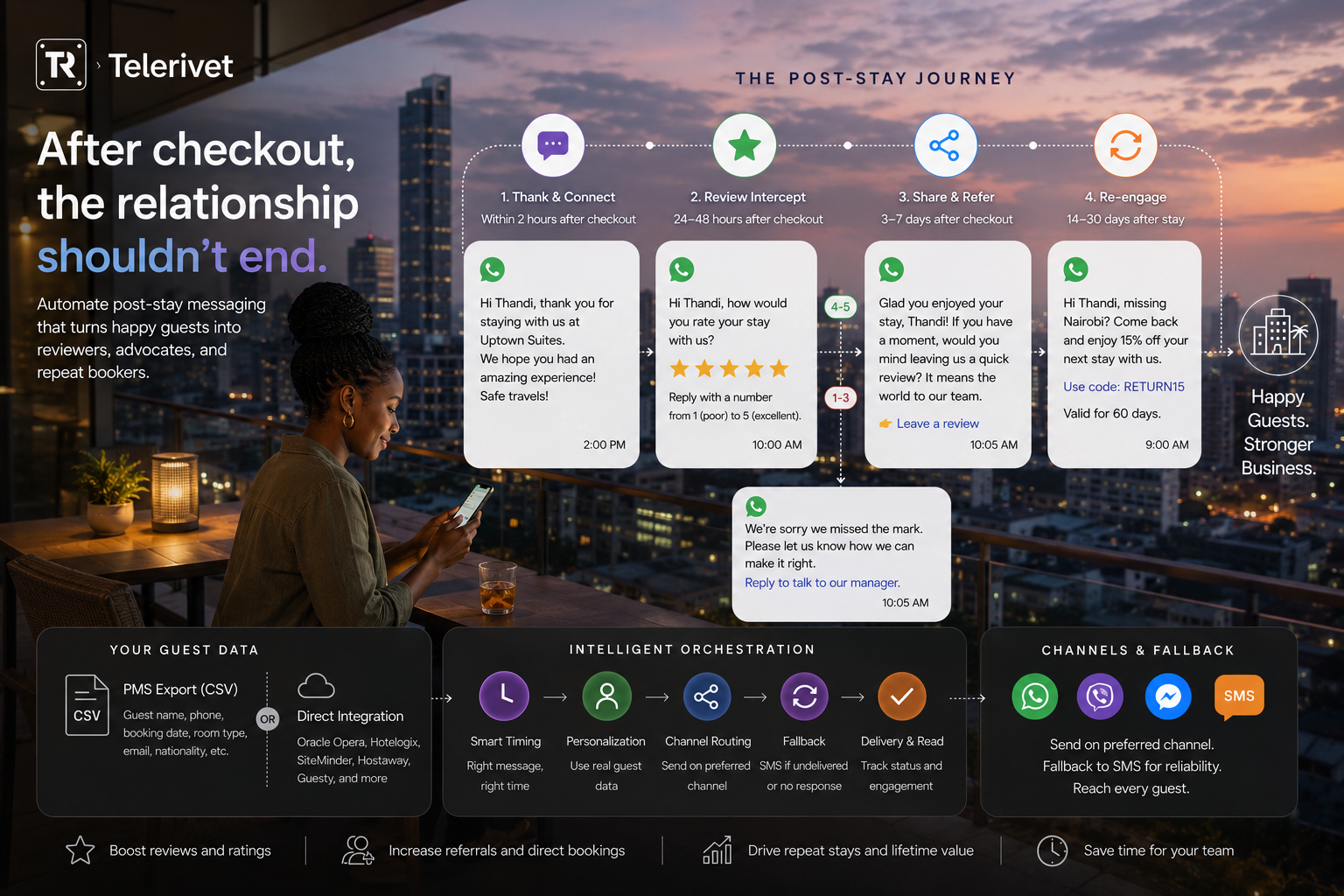
What is post-stay hotel messaging? Post-stay messaging refers to automated communication sent to guests after checkout. For boutique hotels and independent hosts, a post-stay sequence typically includes a satisfaction check, a branching review request that routes positive responses to a public review platform and negative responses to a private resolution path, a referral or discount code, and a re-engagement message ahead of the next booking season. WhatsApp is the most reliable channel for post-stay communication with international guests because it works on WiFi regardless of which SIM the guest is using after returning home.
The guest has checked out. They are in a taxi to the airport, or already at the gate, or back home sorting through their photos. For most boutique hotels, independent resorts, and multi-property Airbnb or Vrbo hosts, this is where the relationship ends. No message goes out. The next communication, if it happens at all, is a generic marketing email weeks later that the guest has already forgotten how to connect to the stay they had..
This is the most neglected window in the entire guest journey, and it is the one with the highest concentration of value. A guest in the first 24 to 48 hours after a positive stay is more likely to leave a review, share a recommendation, and respond to a re-engagement offer than at any point afterward. The enthusiasm is there. The memory is fresh. Most properties let both expire without making contact.
The pre-arrival sequence builds the channel relationship. The in-stay sequence generates ancillary revenue. Post-stay is where that investment compounds or quietly goes to waste.
Why the Channel Matters More After Checkout Than Before
Before arrival, SMS is a reliable fallback. The guest is still in the destination country, their local SIM is active, and a text message reaches them. After checkout, that assumption breaks. A guest flying home from Bali to Amsterdam, from Zanzibar to Toronto, from Chiang Mai to Seoul, or from the Maldives to Mumbai has often swapped SIMs by the time the plane lands. An SMS sent to their Philippine or Thai number goes undelivered. An email competes with everything else in an inbox they are catching up on after a trip.
WhatsApp, Viber, and Messenger work on WiFi from anywhere in the world. The conversation thread the hotel or host opened during pre-arrival contact is still there on the guest's phone, regardless of which SIM they are using. For independent properties in destination markets -- Palawan, Phuket, Marrakech, Cape Town, Sri Lanka, Kenya's coast, where the majority of guests are international travelers, this is not a minor operational detail. It is the difference between post-stay communication that actually reaches people and one that does not.
For multi-property Airbnb or Vrbo hosts in markets like Seminyak, Chiang Mai, or Cape Town, the same logic applies. The guest who booked through the app and messaged through WhatsApp during the stay is reachable post-checkout on exactly that channel and nowhere else reliably.
The Review Intercept Sequence
Review velocity matters enormously for independent properties. A boutique hotel in Vietnam with 200 Google reviews can absorb an occasional three-star. An Airbnb or Vrbo host in Nairobi with 35 reviews cannot. A short-term rental operator building a portfolio in Phuket or Lisbon needs a steady flow of positive reviews to stay competitive in search ranking. Manual review requests, sent when someone remembers to send them, produce inconsistent results.
The more effective approach is a two-step sequence that runs automatically after checkout. The first message is a satisfaction check: a simple question asking how the stay was, framed conversationally rather than as a survey. If the guest responds positively - a four or five out of five, or any equivalent affirmative, the second message fires immediately with a direct link to the review platform of their choice. Google Reviews for most markets. TripAdvisor for properties where that audience is strong. Agoda for Southeast Asian properties where it carries significant booking weight. You get to chose your review platform of choice or even give your guest options.
If the guest responds with a lower score, the sequence branches. Instead of a review link, the message routes to a resolution path: an apology, a direct contact for the GM or host, an offer to make it right. The guest gets a private channel to express their dissatisfaction. The property gets the chance to resolve it before it becomes a public review. Most guests who feel heard do not go on to leave a damaging public post.
This is a workflow that branches on response and it runs without manual intervention once configured. For a multi-property operator managing guest communication across ten units in Cape Town or eight villas in Krabi, automating this sequence is the only realistic way to maintain review velocity across the whole portfolio.
Word of Mouth and the Shareable Referral Code
Independent boutique hotels and short-term rental hosts do not have loyalty programs. They do not have referral apps or points systems. What they have is a guest who just had a good experience and is about to return to a social network full of people who travel.
A post-stay WhatsApp message carrying a discount code the guest can share with friends is the closest equivalent to a referral program that requires no infrastructure to build. The code is unique to that guest, trackable, and gives the recipient a concrete reason to book rather than just a vague recommendation. For destination properties - a lodge in the Masai Mara, a riad in Fes, a surf resort in Siargao, word of mouth from a returned traveler is the highest-converting acquisition channel available, and it currently goes entirely unstructured at most independent properties.
The non-local guest dynamic strengthens this further. A guest back home in Dubai, Seoul, or London sharing a discount code with their network is marketing in a geography the property's own budget cannot reach.
Content and Memory Capture
Checkout is also the moment to access the content the guest is carrying with them. Photos, video, story - all of it is at its most shareable in the 24 to 48 hours after a stay, before it gets buried in the camera roll.
A message asking if the guest would like to share their best shots, with a simple WhatsApp reply mechanism, occasionally produces content worth far more than any paid media equivalent. A short reel from a rooftop pool in Kuala Lumpur, a sunrise shot from a lodge in Tanzania, a table setting at a cliffside restaurant in Santorini: this is material the property cannot produce internally at any budget and the guest is often happy to share if asked directly rather than through a generic social tag request.
For properties with a photographer or someone on the team with photography skills, which is common at boutique resorts in destination locations, the reverse works equally well. Sharing the professional shots taken during the stay, a candid at dinner, a portrait by the pool, a group photo on an excursion, gives the guest a reason to engage with the post-stay message that has nothing to do with a review request. The engagement happens first. The ask follows naturally in a thread the guest already opened to receive something of value.
Beyond photos, a specific story prompt outperforms a generic ask. "What was the moment that surprised you most?" or "what would you tell a friend considering this trip?" produces responses that function as usable marketing copy with implied permission. A request for local discoveries - spots the guest found that the property should be recommending is genuinely useful and positions the guest as a contributor rather than a marketing target.
Personalization at this stage matters more than anywhere else in the sequence. A message that references something specific from the stay - an anniversary dinner, a room upgrade they requested, an activity they booked lands as a continuation of hospitality. The same message without that reference lands as an automated template. Both are automated. Only one feels like it.
Re-engagement and the Repeat Booking
A guest who stayed once is dramatically cheaper to convert than a new acquisition. They know the property, they have the contact saved, and they are in a channel thread that is already warm. A re-engagement message sent at a strategically timed interval, three to four months after checkout, ahead of the booking window for the next relevant season is a direct revenue line that most independent properties are not running.
For Airbnb or Vrbo hosts, this sits alongside the referral code as the clearest available alternative to the loyalty infrastructure that chains have and independent operators do not.
A Note on Compliance and Consent
Post-stay messaging is the point in the guest journey where consent and opt-out handling matter most. The commercial relationship has technically concluded at checkout, and continued outreach needs to be grounded in a clear basis, typically the legitimate interest established during the stay, or an explicit opt-in to post-stay communication at check-in.
Practically, this means every post-stay sequence should carry a clear and easy opt-out mechanism, and that opt-out should suppress all future automated contact for that guest. For properties with a significant volume of European guests, GDPR principles apply to how contact data is retained and used after the stay ends. For properties operating in markets with their own data protection frameworks like South Africa's POPIA, Kenya's Data Protection Act, Thailand's PDPA, local rules govern post-stay communication in ways that vary by jurisdiction.
The principle-level approach that keeps a post-stay sequence compliant across most markets: message within a reasonable window after checkout, make the purpose of each message clear, and make opting out as easy as replying with a single word. Beyond that, any property operating at significant volume in a regulated market should take local advice on the specific requirements that apply to them.
The guest journey does not end at checkout. For most independent hotels and hosts, it currently does - not by design but by default. The post-stay window is short, the guest's attention is finite, and the opportunity to convert a satisfied stay into a review, a referral, a content contribution, and a future booking closes faster than most properties realize. The sequence that captures that value is not complicated. It is just not being sent.
Frequently Asked Questions
When should a hotel send a post-stay message? The highest-engagement window is within 24 to 48 hours of checkout, while the guest's experience is still fresh. A satisfaction check sent in this window produces significantly higher response rates than messages sent days later.
How does a hotel review intercept sequence work? The guest receives a satisfaction check message after checkout. If they respond with a positive score, an automated follow-up sends a direct link to Google Reviews, TripAdvisor, or Agoda. If they respond with a low score, the sequence routes to a private resolution path rather than a public review link, giving the property a chance to address the issue before it becomes a public complaint.
Why use WhatsApp for post-stay messaging instead of email? International guests frequently change SIMs after returning home, making SMS unreliable post-checkout. Email open rates are low for post-stay communication. WhatsApp operates over WiFi and remains accessible on the same number the guest used during the stay, regardless of their current location.
Can Airbnb hosts automate post-stay messaging? Yes. Multi-property Airbnb hosts benefit from post-stay automation in the same way boutique hotels do. Review velocity is particularly important for short-term rental operators because a small total review count makes each individual rating more consequential. An automated post-stay sequence running across a portfolio of properties maintains consistent review outreach without requiring manual effort per booking.
Telerivet supports multi-channel hotel guest communication across WhatsApp, Viber, and SMS from a single workflow layer.
