WhatsApp lead capture at an auto show is the use of a QR code or short number displayed at a brand stand to initiate a WhatsApp conversation with a visitor, collecting contact details, qualifying interest, and routing the lead to the right follow-up workflow, all without paper forms or manual data entry. The operational advantage is that the lead exists in a structured, actionable format before the visitor has left the floor. The most common alternative, collecting paper forms and entering them manually after the event, loses between 20% and 40% of leads to illegible handwriting, incomplete entries, or delayed follow-up..
Auto shows generate leads. They rarely generate follow-up. A brand spends weeks preparing a stand, ships vehicles across the country, and puts staff on the floor for three or four days. At the end of it, the asset they walk away with is often a pile of paper forms, a notebook of numbers written down by sales reps, or a WhatsApp group that nobody quite owns.
The problem is not that people at auto shows are unwilling to share their details. The problem is that the data collection moment and the follow-up moment are completely disconnected. A form filled at a stand on Saturday morning needs to be typed into a spreadsheet on Monday, and followed up by someone who was not at the show and has no context about what the customer said they were interested in. Most leads do not survive that gap.
There is a different way to run this.
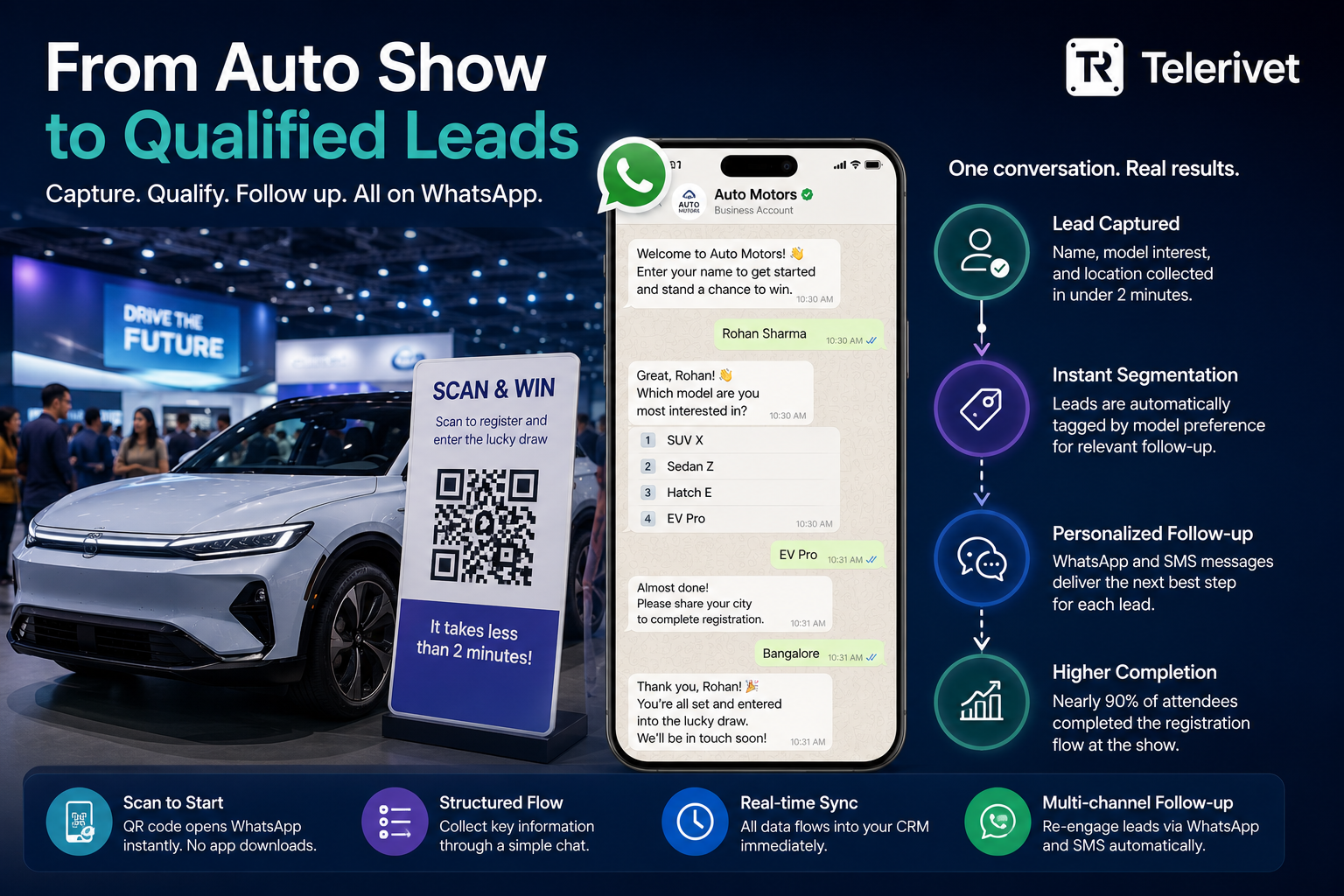
The WhatsApp Registration Flow
An EV distributor in South Asia running multiple international brands built a WhatsApp-based lead capture flow for their appearance at a national auto show. The mechanics were straightforward: a QR code displayed at the brand stand opened a WhatsApp conversation automatically when scanned. No app download, no form, no sales rep involvement at the registration step.
The conversation that followed had three steps. The customer was greeted and asked to type their name to enter a prize draw. Once they provided their name, they received a menu of five EV models and were asked to select the one they were most interested in. After selecting a model, they were asked for their address to complete their contest entry. The system confirmed their registration and entered them into the draw.
That is the entire flow. Name, model preference, address. Under two minutes from scan to completion.
Of the attendees who started the conversation, nearly nine in ten completed all three steps - a completion rate that would be difficult to match with a paper form and a manual follow-up process.
Why the Completion Rate Is That High
Two things drive that number. The first is friction reduction. The customer is already on their phone at the show. Scanning a QR code and typing three responses in a conversation they already know how to use is genuinely easy. A paper form requires finding a pen, reading instructions, and handing something to a person. A WhatsApp conversation requires none of that.
The second is the contest mechanic. Entering a "Scan & Win" prize draw is a natural reason to complete a registration. The customer gets something for their time - a chance at a prize and the brand gets a completed, structured contact record. The prize does not need to be large. The point is that completing the conversation has a visible payoff, which is different from filling out a form that goes into a box.
For more on how conversational flows drive completion in consumer-facing campaigns, the FMCG orchestration post on this blog covers the same mechanic applied to retail activations. The underlying logic is identical across contexts.
The Registration Is Also the Segmentation
The model preference step is not just data collection. It is the segmentation event. The moment a customer selects a specific model from the menu, they are automatically added to a contact group for that vehicle. The follow-up sequence that fires after the show - the one referencing the specific model they expressed interest in does not require anyone to manually sort a spreadsheet. The conversation already sorted it.
Most event lead collection assumes a sequence: capture first, segment later. A form at a booth on Sunday gets typed into a spreadsheet on Monday, sorted by interest on Tuesday, and handed to someone for follow-up on Wednesday. By then the customer has forgotten what they said they were interested in.
This workflow collapses that sequence. Capture and segmentation happen in the same moment, in the same conversation. The follow-up is ready before the customer leaves the stand.
What Happens After the Show
The contacts captured at the show entered active follow-up sequences within the same WhatsApp channel. Customers who had clicked links but had not initiated a follow-up conversation received a triggered re-engagement message within minutes, first via WhatsApp and then via SMS if they did not respond. The distributor also ran a newsletter subscription through the same infrastructure: customers who texted a keyword received a link to the brand's quarterly publication, and their subscription was recorded automatically.
The show-floor registration and the post-show communication ran on the same contact database, with no manual transfer step between them. The QR code at the stand was the entry point to a relationship that continued past the event.
This Works at Any Event, in Any Industry
What makes this approach useful well beyond automotive is that the QR-to-conversation pattern generalizes cleanly to any situation where you need to register people quickly, collect structured preference data, and follow up at scale without a large team.
Real estate developers capturing property leads use the same structure at showroom launches and property expos: scan, name, unit type interest, location preference, confirmation. Health campaigns run it for beneficiary registration at community outreach days, where collecting a name, location, and health concern via a structured conversation replaces a clipboard and a data entry session back at the office. FMCG brands activate it at retail events and consumer promotions, using the conversation to capture a phone number and product preference before handing over a sample or a prize. Financial services operators run it at agent banking rollouts and product launches, routing interested customers directly into a qualification sequence from the moment they scan.
The industries are different. The underlying mechanics are identical in each case: a trigger (QR code, keyword, short link), a structured conversation that collects two or three specific data points, a completion incentive, and an automatic handoff to a segmented follow-up sequence. What changes is the question at step two: model preference for an auto brand, property type for real estate, service interest for a bank, health concern for a clinic.
The pattern works globally because WhatsApp penetration is high across emerging markets in South Asia, Southeast Asia, sub-Saharan Africa, and Latin America, and because the mechanics require nothing from the participant beyond a phone they are already carrying. A QR code at a stand in Nairobi, Lagos, Manila, or Mumbai produces the same structured contact record - immediately segmented, immediately actionable, with no manual processing step between the event and the follow-up.
None of this is specific to WhatsApp. The same conversation flow runs on Viber, Facebook Messenger, Telegram, or any other chat app that is the dominant channel in your market. If your audience in Vietnam is on Zalo, or your audience in the Philippines skews toward Viber, the QR code points to that channel instead. The registration mechanics, the segmentation logic, and the follow-up sequences work the same way regardless of which app handles the conversation. The channel is a variable. The workflow is not.
For a full picture of how this fits into the broader automotive customer journey, see the pillar post on automotive customer communication. For a deeper look at how WhatsApp fits into an enterprise communication workflow, including channel routing and multi-number setups, that post covers the architecture in more detail.
Frequently Asked Questions
How does WhatsApp lead capture work at an auto show? A QR code displayed at the stand or a short number printed on collateral prompts visitors to send a message to the brand's WhatsApp number. An automated workflow responds immediately, collects qualifying information (name, model interest, intended purchase timeline), and logs the lead with a timestamp and the visitor's WhatsApp contact. The lead is routed to a sales representative or dealership queue based on the model interest and location. The entire capture-to-routing sequence runs without manual input from staff at the stand.
Why is WhatsApp better than paper forms for event lead capture? Paper forms require manual data entry after the event, introduce transcription errors, and lose the time-sensitivity of the lead. A WhatsApp-captured lead is immediately actionable: the contact is already in the system, the qualifying information is structured and searchable, and the follow-up message can be sent within minutes of the conversation ending rather than days after the event closes. For events where competitor brands are also present, speed-to-follow-up is a material conversion factor.
How do you handle multiple dealerships or territories in a WhatsApp lead capture workflow? The qualifying workflow asks the visitor for their location or preferred dealership early in the conversation. Based on the response, the lead is routed to the correct dealership WhatsApp number or CRM queue. If the brand operates a national lead center, all leads flow there first and are distributed based on territory logic configured in the routing workflow. The key requirement is that the routing logic is automatic, manual lead distribution after the event introduces the same delay and attrition as paper forms.
What follow-up sequence should run after an auto show WhatsApp lead is captured? The immediate follow-up (within 24 hours) should reference the specific model and conversation from the show. Within 72 hours, a test drive invitation or product information package should go out. At 7 days, a follow-up checking on purchase intent. The sequence should include a clear opt-out at each stage. For leads that do not convert within 30 days, a longer-term nurture sequence (monthly) keeps the brand present without overloading the contact. The entire sequence should be automated from the moment the lead is captured, not manually triggered by a sales representative.
Telerivet supports two-way WhatsApp flows for automotive lead capture, event registration, and post-show follow-up. See how it works
