On connection, and the oldest thing we do.
Long before we had a word for it, we were already doing it. We looked up at a scattering of unrelated lights, impossibly far apart, and we drew lines between them. We called the lines hunters and rivers and bears. We told stories along them. We turned a random spray of distant fire into something that could be read, remembered, and handed to a child who would hand it to hers. The constellation was never in the sky. It was the line we drew. Meaning was the connection we made between things that were, until we connected them, alone.
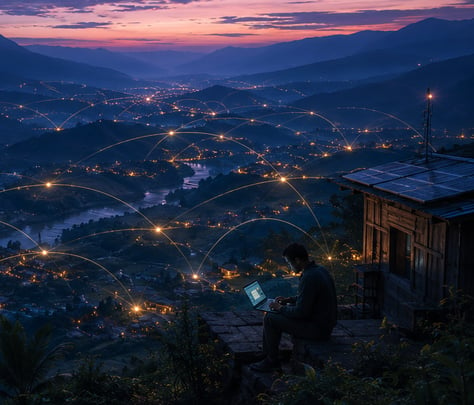 Look down from a hillside at dusk and you will see the same scattering, turned earthward.
A valley fills with lights as the dark comes on, and each one is a kitchen, a clinic, a phone in someone's hand, a person who is, at that moment, an island. For almost all of human history, distance meant silence. The light across the valley might as well have been a star. You could see it. You could not reach it. To carry a single word over those mountains, someone had to walk it there, and sometimes the word arrived and the runner did not.
What changed is not that the distance shrank. The mountains are still exactly where they were. What changed is that we learned, at last, to draw the lines ourselves. To send a thread of light from one small place to every other light in the valley, in the language each light speaks, on whatever channel happens to reach it, and then, the part that is genuinely new, to listen for the light that answers back.
Because just reaching someone was never the magic. Broadcasting into the dark is the easy, lonely half of it. A drumbeat carries. A signal fire carries. The magic is the answer. It is the back and forth, the question heard and the question returned, the moment a thread stops being a message and becomes a conversation. That is the whole difference between shouting across a valley and actually speaking to it.
Consider what the answer actually is, when it comes. Not information returning in the opposite direction. Acknowledgment. It says: I received you. The signal found me. I am here, and I am real, and I am not alone in this particular dark. A broadcast can reach a million people and leave every one of them unreached, if no one writes back. The crowd that answers is not a crowd. It is a million separate persons, each one briefly known.
We have always understood this. The prayer was never just a sending. It was a waiting.
This is the quiet thing a person with a laptop on a hillside can now do. Not send. Orchestrate. Draw a thousand separate lines at once, across a hundred and fifty countries' worth of valleys, each line a real exchange with a real person who replies in their own words and is answered in turn. One hand, conducting a sky's worth of conversations. What once cost a runner his life on the mountain is done now without looking up, by someone who has forgotten it was ever impossible.
We are still the species that draws lines between the lights. We have only turned the gift around. The constellations we make now are not stories told about the dark. They are the dark itself, learning to talk back.
And every line still begins the same way it always has. Someone, somewhere, decides that the light across the valley should not have to stay alone. And then waits for it to answer.