Intent-driven orchestration is a model in which software accepts a description of a desired outcome in plain language or structured intent and configures itself to execute it, rather than requiring a human operator to build the workflow step by step. In communication systems, this means describing a messaging sequence to an AI agent and having the platform build, route, and run it automatically. It is the shift from configuring software to instructing it.
For the last two decades, enterprise software has followed the same basic model: businesses adapt themselves to software..
Teams learn dashboards. Operators configure workflows. Specialists get hired to maintain automations that were supposed to run themselves. Entire functions emerge whose sole purpose is administering systems that were originally supposed to simplify operations.
The software becomes the job. And every year, it gets a little heavier.
AI changes the interaction model entirely. Instead of manually stitching together workflows across dozens of menus, operators can increasingly describe intent directly.
"Launch a WhatsApp onboarding flow for new policyholders."
"Identify inactive customers likely to churn and create a re-engagement sequence."
"Route support conversations differently for high-value accounts."
This does not eliminate complexity underneath the system. In many cases, the underlying infrastructure becomes more sophisticated. But the complexity moves lower in the stack. The interface becomes conversational. The orchestration layer becomes more important than the configuration screen.
The Hidden Dependencies That AI Exposes
This shift exposes something that fragmented operational environments have been hiding for years.
Most businesses are running customer communication on systems that were never fully designed to work together. Messaging lives in one platform. Customer data lives in another. Automation rules sit somewhere else. Campaign lists get exported manually. Suppression logic lives in a shared document that may or may not be current.
It holds together, but often because someone is quietly compensating. They are the integration layer. They are the reason the right message reaches the right customer at the right time.
That works until it doesn't.
Consider what happens when that person leaves, or when the business expands into a new market, or when a channel outage hits at 2am and there is no fallback logic because no one ever formalized it. The system that felt stable reveals that it was never really a system at all. It was a set of workarounds held together by institutional knowledge.
AI makes those gaps visible very quickly. Large language models are capable of interpreting intent at a level that was not possible before. But that intelligence is only as reliable as the infrastructure beneath it. Structured data, execution systems, permissions, routing logic, and orchestration layers that can consistently carry out actions do not become less important in an AI-native world.
They become the foundation everything else depends on.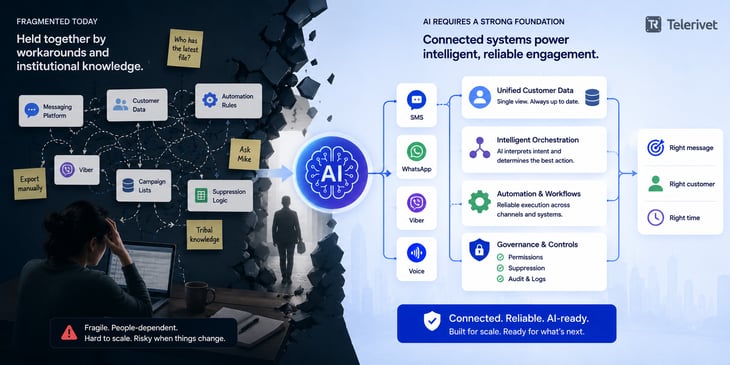
From Messaging to Orchestration
Nowhere is this more apparent than in how organizations communicate with customers.
Conversations now move across SMS, WhatsApp, RCS, email, voice, and whatever channel a given market uses for everyday interaction. Customers expect those experiences to feel continuous, even when the systems behind them are not. A customer who starts on WhatsApp and continues on SMS should not have to repeat themselves. A workflow built for one market should extend to the next without rebuilding. A provider outage in one region should trigger failover before anyone notices.
These are not messaging problems. They are orchestration problems.
Sending a message has never been the hard part. Coordinating context, timing, routing decisions, fallback logic, and customer state across channels and markets, reliably and at scale, is what separates operational communication from fragmented noise.
As we explored in The Hidden Orchestration Layer in Customer Communication Systems, this coordination layer is rarely discussed, yet it quietly determines how resilient a communication system becomes over time. Most teams discover it the same way: a regional expansion, a channel outage, a provider change. Suddenly the "simple" messaging setup reveals a dozen hidden dependencies. That moment is when leaders realize they are not managing channels. They are managing infrastructure.
Infrastructure Is Now the Competitive Layer
AI is compressing the distance between business intent and operational execution across enterprise software broadly. The question shifts from how do I configure this? to how do I express the outcome I want?
That does not reduce the importance of infrastructure. It increases it.
The more intelligence you introduce at the top of the stack, the more discipline you need in the layers underneath. AI-driven personalization assumes that customer context is consistent across channels. AI-triggered workflows assume that execution is predictable. AI-generated content assumes that messages actually arrive. If any of those assumptions fail at the infrastructure level, the intelligence above it fails with them.
The organizations navigating this well are not necessarily the ones with the most sophisticated AI. They are the ones that built a reliable orchestration layer first, one that can absorb new channels, new markets, and new forms of automation without requiring a rebuild each time.
When infrastructure is working, you see it in the details: a workflow that extends to a new market without rewriting existing logic, costs that shift automatically when a route degrades, a customer experience that feels continuous even as the systems behind it evolve.
The Platforms That Win Will Be Built for This
The platforms that define the next decade of enterprise software will combine orchestration depth, structured operational data, execution reliability, and real-time context. They will feel simple on the outside. They will remain stable underneath.
The winners will be the platforms that can reliably turn intent into execution across fragmented systems, channels, providers, and markets.
That is the real transition happening now. Not the end of complex software.
The beginning of software that understands intent, and has the infrastructure to act on it.
Frequently Asked Questions
What is intent-driven orchestration? Intent-driven orchestration is a software model where the operator describes what they want to happen - a business outcome, a workflow goal, a communication sequence and the system configures itself to execute it. The alternative is the traditional model: the operator manually configures each step, trigger, condition, and action. Intent-driven systems invert this. The operator provides the intent. The platform handles the configuration and execution.
How is intent-driven orchestration different from workflow automation? Workflow automation requires a human to explicitly define each step, trigger, condition, and action in advance. Intent-driven orchestration abstracts that process: the human or AI agent describes the goal, and the system generates and executes the underlying workflow. The distinction matters most in complex, multi-step, multi-channel scenarios where manual configuration is slow, error-prone, or requires specialized technical knowledge.
Which enterprise software categories are moving toward intent-driven models first? Communication platforms, CRMs, and operations management tools are the leading categories. Communication is particularly well-suited to intent-driven orchestration because workflows are often conditional and multi-step, exactly the kind of complexity that natural-language instruction handles better than manual step-by-step configuration.
What does intent-driven orchestration look like in a communication platform? An operator describes: "Send a payment reminder to borrowers three days before their due date. If there is no response within 24 hours, follow up by WhatsApp. If the payment is not received by the due date, trigger a voice call and notify the account manager." The platform parses that description, configures the trigger, routing, and escalation logic, and runs the workflow without the operator building each step manually. That is intent-driven orchestration applied to communication.
See how Telerivet is built for this layer.
