A text-to-win SMS contest is a consumer promotion where participants register by sending a keyword to a number, are entered into a prize draw, and receive match-linked engagement messages until winners are announced. The entire interaction happens over SMS, with no app download, no form to fill out, and no internet connection needed at the point of entry.
The FIFA World Cup is the biggest single-brand activation window in consumer marketing. For beverage companies, retailers, restaurants, and brands running promotions across physical locations, it is also a rare moment when consumers are already primed to engage. They are watching matches on-site, phone in hand, in a participatory mood. The question is how to turn that energy into a first-party contact list your brand actually owns.
If your brand is running activations during this year's tournament and you want a mechanic that works across every location and reaches every consumer regardless of what phone they are carrying, here is how the pattern works and what one brand did with it.
Why SMS and Not a Form or App
The question comes up in every activation planning conversation. The honest answer is that SMS wins on reach, not convenience.
A QR code that opens a form works well at a modern bar with reliable Wi-Fi and a digitally savvy consumer with the patience to go through the process. It works poorly at an outdoor venue in a provincial city, at a traditional retailer in a mixed-connectivity market, or anywhere the consumer does not have mobile data at that moment. Assumptions about which channels your audience can actually access are what sink otherwise well-designed campaigns. SMS reaches every phone on every carrier regardless of whether data is active, which matters most when your activation footprint spans flagship venues and neighborhood outlets at the same time.
How the Registration Flow Works
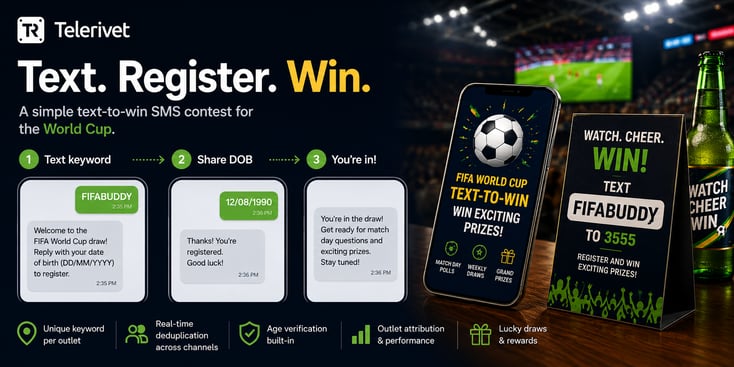
The consumer sees a number and a keyword displayed at an outlet or on campaign materials. They text the keyword. They receive a welcome message asking for one piece of information, usually date of birth for age verification. They send it back, get a confirmation, and they are in the draw.
If you have multiple outlets, each one gets its own unique keyword, which means you know exactly where every registration came from. That attribution data tells you which locations are performing and which ones need attention. It also makes prize fulfillment straightforward, because you already know which zone each winner registered from before the draw runs.
A beverage brand in South Asia ran this registration pattern across more than 70 outlets and restaurants during the 2022 FIFA World Cup, simultaneously accepting registrations from outlet codes, a social media keyword, and a website opt-in, with all three channels feeding into one contact list without duplicates. The same flow works just as cleanly for a supermarket running a point-of-sale promotion, a restaurant chain rewarding viewing party guests, or a telco offering prizes to subscribers who pick the winning team.
The Match Day Engagement Layer
Registration builds the list. What you do with it during the tournament is what makes it worth having.
The mechanic that works best for a sporting event is a match prediction poll: a message goes out to all registered contacts before each game asking them to reply with their pick. Responses come back, the winning team's supporters go into a special draw pool, and after the final whistle results and winner names are broadcast to everyone. Converting registrants into repeat participants is a different problem than getting them to sign up in the first place, and a well-timed poll before a high-stakes match is one of the most effective ways to do it.
Response rates for these polls, in the deployment referenced above, held at 50% or higher. SMS works particularly well for this format because all it asks of the participant is a single digit reply. The barrier is as low as any engagement mechanic can go.
Running the lucky draw after each match is simpler than it sounds. The draw pool is whoever voted for the winning team. A winner gets a personalized congratulations message. The outlet where they registered gets notified at the same time, with the winner's name and number for identity verification before the prize is handed over. When the winner collects, they confirm with a reply text. No ghost redemptions and no manual reconciliation at the end of the week.
At scale, SMS contest mechanics can also attract duplicate entries, fake registrations, and coordinated redemption attempts. The good news is that most of the protection you need is built into the flow itself: date validation at registration, per-contact deduplication across channels, and the two-step reply confirmation on prize collection. For a fuller breakdown of how to protect an SMS rewards program from abuse without a dedicated fraud platform, the post covers specific failure modes and how each one gets closed.
The Referral Layer
The part of the deployment that produced the most unexpected result was the referral mechanic. After completing registration, each contact received a unique shareable code with a simple prompt: share this with a friend, and if they register using it, you both get an extra draw entry.
The contact list grew 3x in a few weeks. Referral became the top source of new registrations, ahead of outlet codes, social media, and outreach combined. A mechanic built entirely within the SMS campaign, requiring no app and no external platform, drove the majority of list growth by the time the tournament reached its final rounds.
The reason it works specifically during a sporting event is timing. A fan who just registered while watching a match is already in a social moment. The referral prompt arrives immediately in the same message thread, right at the engagement high point. The sharing happens at the table, not three days later when the feeling has passed.
Running a promotion like this without a dedicated promo management platform is entirely possible when the registration and reward logic lives in the messaging layer itself.
The World Cup is the occasion here, but the mechanic is not specific to football or to any single event. A regional cricket tournament, a festival season promotion, a store anniversary, a product launch tied to a national holiday: the same registration flow, prediction poll, and referral loop applies. The contact list you build during one event becomes the audience for the next one, which means the value of running it well compounds over time.
A Few Things to Sort Before You Launch
None of these are complicated, but each one tends to be discovered at the wrong moment if not addressed upfront.
Plan for campaign-scale volume. The messaging volume during a match is nothing like a regular broadcast day. Make sure your account limits are set to handle the spike before the campaign goes live, not after the first error arrives at halftime.
Add opt-out from day one. As daily match messages accumulate, some contacts will want to stop. A STOP keyword that removes someone from broadcast groups while keeping their registration record intact is what keeps your list healthy and your consent posture clean for everything that comes after the tournament.
Capture additional information in a separate step. If you want to address winners by name, ask for it after the date of birth is confirmed, not in the same reply. One ask per message produces clean data. Asking for both at once produces entries you cannot use.
The communication orchestration across registration flows, poll broadcasts, lucky draws, and winner notifications is manageable as a single campaign because all of it runs through one platform with one contact record per person. That is the practical argument for running multi-channel consumer activations through a unified workflow layer rather than stitching together separate tools for each mechanic. For the full picture of how brands are building multichannel promotional campaigns without multichannel operational overhead, that post covers the structural thinking in detail.
For brands thinking about the full messaging playbook beyond this tournament, the five workflows that show up most consistently across consumer brand deployments are worth reviewing alongside this one.
FAQ
Do participants need a smartphone to enter a text-to-win contest? No. An SMS text-to-win works on any mobile phone capable of sending a text message, including basic and feature phones. This is one of the main reasons the format outperforms QR-code-to-form approaches in markets with mixed device penetration.
How do you handle age verification if required? Date of birth is captured as a conversational step after the initial keyword registration. The platform validates the format and checks the submission against the legal age threshold for the market. Contacts who do not clear the threshold are rejected and not added to the draw pool or broadcast groups.
Can the same campaign run on multiple channels simultaneously? Yes. A text-to-win can run across outlet codes, a social media keyword, and a website opt-in at the same time, with separate source tracking and shared contact deduplication. Channel attribution is preserved throughout the campaign.
What happens to the contact list after the tournament ends? The list belongs to you. Registrants who did not opt out are a first-party audience for whatever comes next: seasonal promotions, product launches, and ongoing loyalty programs that keep the relationship going past the final whistle. Protecting brand loyalty with an engaged list is considerably easier when the list was built through active participation rather than a data purchase. The contact base built during one World Cup is the starting point for the next campaign.
See how Telerivet handles text-to-win registration, lucky draws, and match day polls. To discuss running a campaign before the final:
