Connectivity completeness is the principle that a communication platform should be able to reach any recipient, on any channel, through any network without requiring the sender to manage that complexity. Routing decisions, fallback logic, and multi-network coverage are handled at the platform level. The operator decides who needs to receive a message and what it should say. The platform determines how to get it there.
Telerivet offers a complete connectivity solution for organizations to communicate in real time with customers, stakeholders, or staff anywhere in the world with an unmatched choice of providers.
Many organizations have been forced to operate in walled gardens, paying a premium on usage due to geography or bundled features. Consolidations and shifts in the communications landscape have driven up prices in certain markets and under-served others.
This has meant that expanding into new geographies or channels can be challenging. It requires working with new providers, new APIs, and new platforms. This all incurs extra costs related to time and training, as well as having to add another tool to your tech stack.
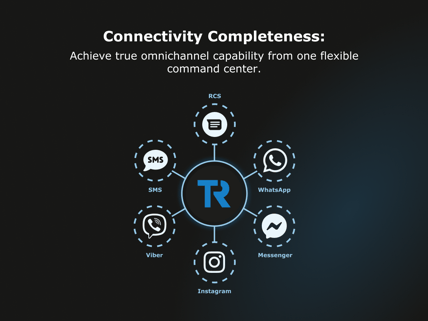
Connectivity doesn’t seem to produce a one-size-fits-all solution, which means the market doesn’t lean to a single provider. The fragmented nature of the market reflects the broad range of ways people can connect. Maximizing one's options leads to the challenge of integrating (and maintaining!) numerous disparate services.
When providers emerge that offer connectivity in a wide range of channels and countries, they often have significantly higher prices compared to local providers that focus on providing connectivity for a single channel in one country. Ultimately, there are segments of customers who lose out.
One loser in these dynamics has been developing economies, and those who operate in them. These dynamics reduce the unit economics of expanding services into certain regions - limiting the innovation opportunities for the local entrepreneurs and existing companies, looking to modernize and digitize. The effect can be seen in its most severe form in the difficulties faced by humanitarian organizations operating in some of the areas with the least stable communications infrastructure.
Instead, imagine if you could separate the channel from the provider and plug in different options depending on factors like performance and price, whenever you wanted to. If you could plug different channels into your universal layer so you could combine them, swap them, turn them on and off, and integrate them seamlessly with workflows and campaign designs.
Connectivity fuels all communications services, and getting it right for the nuanced realities of your geography, industry, and use cases is essential. When you get it right, your innovations scale, creating value for everyone – you, the people who use your services, and the connectivity ecosystem.
Telerivet’s powerful connectivity deployment engine delivers industry-leading true global service reach. But what does this mean in practice?
- Unrivaled ability to deploy complete connectivity anywhere in the world:
- Spend optimization for connectivity:
- To minimize connectivity spend, clients need leverage with providers. Telerivet’s flexible connectivity technology means clients can plug in a wide array of providers and options. Our "Bring Your Own Connectivity" (BYOC) option means you are never locked in to a single provider. It is an architectural commitment to operator sovereignty.
An organization’s connectivity journey starts with an immediate need, ranging from simple inbound message handling, to marketing broadcasts, to OTPs, to chat app bots, or even mobile reward disbursements. Ultimately, as organizations have success with their mobile communication efforts, their needs often advance to a broader connectivity picture including:
- Two-way capable SMS
- One-way SMS broadcasts capable of high volume
- Chat app support (such as WhatsApp or Viber)
- Ability to incentivize and reward contacts with airtime or mobile reward bundles.
- In certain markets, USSD and Voice.
All these channels can be accessed and integrated with Telerivet. Plug in the providers and gateways that work best for you. Telerivet’s campaign manager, automated service builder, and contact data platform enable sophisticated, custom use cases, as well as simple ones such as broadcasts and polls.
Democratizing connectivity brings an improvement in the quality and the reach of services. It means that superapps in South East Asia can lean on best-in-class infrastructure at market appropriate costs. It means tech companies in the US aren’t trapped by expensive providers because they’d built those systems into their products. And it means humanitarian organizations doing crucial work in unstable locations can deploy their essential communications gateways how they need them, when they need them.
Telerivet orchestrates the activities of an array of partners so that joint efforts increase value for all participants. This accelerates innovation around today's mass-engagement technologies.
Connectivity completeness is about bringing best-in-class services to everyone, anywhere.

Frequently Asked Questions
What is connectivity completeness? Connectivity completeness is the idea that a communication platform's job is not just to send messages, but to guarantee that they reach their recipients regardless of which channel those recipients use, which network they are on, or what device they carry. A platform with connectivity completeness handles the routing, fallback, and multi-carrier logic automatically. The operator does not need to configure a separate solution for each market or channel.
Why is channel coverage not the same as connectivity completeness? Supporting a channel having WhatsApp, SMS, and Viber available on a platform does not mean every recipient can be reached through that channel. Connectivity completeness goes further: it means the platform can dynamically route to whichever channel and network actually reaches a specific recipient in their specific context. Supporting five channels is a feature list. Routing reliably across all five for every recipient in every market is connectivity completeness.
How does connectivity completeness differ from multichannel messaging? Multichannel messaging means having more than one channel available. Connectivity completeness means the platform manages the complexity of which channel to use and when, rather than passing that decision to the operator. The distinction matters most in markets where device types, internet access, carrier coverage, and channel preferences vary significantly across a customer base.
Which markets benefit most from connectivity completeness? Any market. Especially, markets where the recipient population is heterogeneous, some on smartphones with reliable data, others on feature phones with SMS only, others in areas where only specific mobile networks have coverage benefit most. This describes most of sub-Saharan Africa, Southeast Asia, South Asia, and parts of Latin America. In these markets, a platform that can only reach the connected, smartphone-carrying segment leaves a significant portion of any customer base unreachable.