Tanzania has 90 million mobile subscriptions and one of the highest mobile money transaction rates in Sub-Saharan Africa. It is also a market where the Tanzania Communications Regulatory Authority has been tightening its grip on commercial SMS traffic since 2023, where every alphanumeric sender ID generally needs to be registered with the relevant mobile network operators before a single message is sent, and where a 2022 data protection law with active enforcement adds a second compliance layer that most operators building SMS programs have not fully accounted for.
Blog
Business SMS in France: GDPR, CNIL, and the 06/07 Number Rule That Catches International Programs
Feb 14, 2026
Since January 1, 2023, commercial messaging platforms in France have not been permitted to send marketing SMS from numbers beginning with 06 or 07. Those are the standard French mobile number prefixes, the numbers that French recipients associate with calls and messages from real people. For commercial SMS, those numbers became unavailable to business platforms. Organizations that set up their French SMS program before that date and have not updated their routing since may be sending from numbers that are no longer permitted for commercial use.
How Logistics Operators Use SMS for Fleet Coordination
Feb 13, 2026
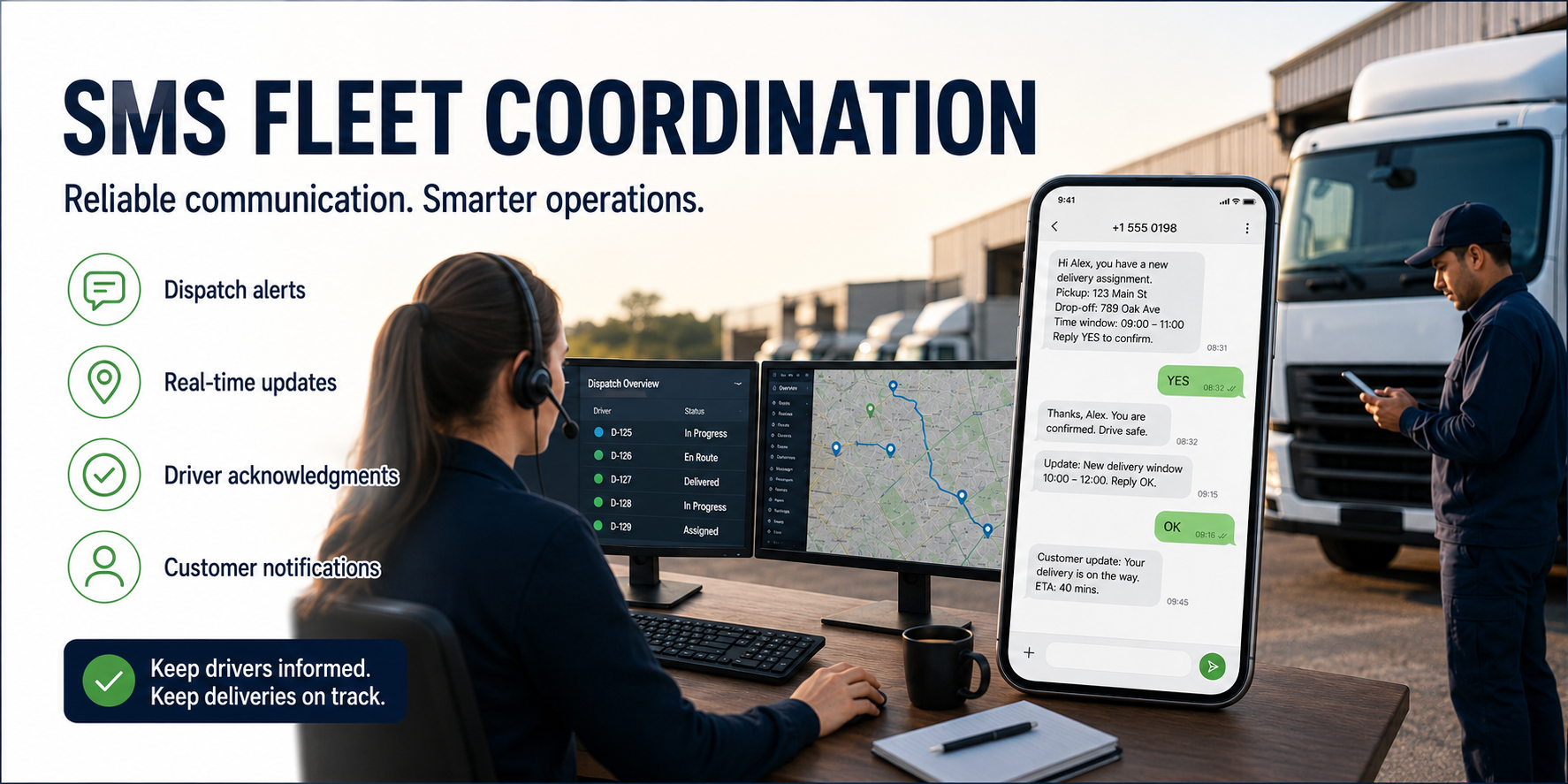
SMS fleet coordination is the use of automated and two-way SMS messaging to manage real-time communication between dispatchers, drivers, and customers across a logistics operation covering route assignments, pickup confirmations, delivery window notifications, proof-of-delivery requests, and exception alerts. It is an operational workflow, not a marketing channel: messages are triggered by dispatch events, delivery milestones, and driver status updates, not by campaign schedules.
Most logistics operators don't go looking for a messaging platform. They find one because they need a better way to manage fleet communication.
Sending SMS in Rwanda: RURA Registration, the Two-Way SMS Gap, and Law 058/2021
Feb 11, 2026
Most teams designing SMS programs for Rwanda discover the two-way limitation after the program is already built. The workflow assumes recipients can reply to confirm, opt out, or respond to a survey. The sender ID is registered, the consent records are in order, and the first broadcast goes out. Then nothing comes back, because standard A2P SMS routes used by most providers do not support inbound replies on MTN Rwanda and Airtel Rwanda.

3 Ways a Communication Orchestration Platform Can Power Your FMCG Profits: Key Use Cases
Feb 5, 2026
FMCG leaders are facing squeezed margins and rising ad costs, making direct customer connection vital for survival.
Here is how communication orchestration turns mobile messaging into a scalable engine for profit and data ownership.
Sending SMS in Kenya: Sender ID Rules, Safaricom Approval, and the Promotional Restriction Most Teams Miss
Feb 2, 2026
Your SMS program is reaching Safaricom numbers. Except the ones that silently dropped. And the campaign you sent after 6 PM that delivered to no one. And the branded sender name you configured that only works on transactional messages, not promotional ones, something your provider may not have mentioned when you set it up.
Sending SMS in Pakistan: PTA Compliance, Four Carriers, and What Makes This Market Different
Jan 31, 2026
Pakistan's mobile market is one of the largest in South Asia and one of the least addressed in business messaging guides. With 193 million mobile subscribers, a population of 253 million of whom approximately 61% live in rural areas, and 116 million internet users as of early 2025, Pakistan is a market where SMS remains the most reliable channel for reaching audiences across both urban centers and rural communities where data connectivity is intermittent or unavailable. For development sector organizations, agricultural programs, financial services, and operational programs coordinating across geographically distributed teams, the case for building a Pakistan SMS program is straightforward. The compliance and carrier architecture that makes it work requires attention to four carriers that behave differently from each other, a national do-not-call registry that must be checked before promotional sends, and a data protection framework that is still developing.
Why SMS Beats Branded Apps and Everything Else in General Trade
Jan 30, 2026
In general trade markets, simple infrastructure often drives the biggest returns.
In this Telerivet article, we'll cover why savvy brands are choosing orchestrated SMS and messaging channels over expensive app development to drive loyalty and sales.
Sending SMS in India: TRAI, DLT Registration, and the Template Scrubbing Layer
Jan 26, 2026
India's SMS compliance system is unlike every other market in this series. In Nigeria, Kenya, and Tanzania, the core requirement is registering a sender name with each operator. In Australia and the US, you register with a centralized authority or registry. India requires you to register three distinct things, your business entity, your sender header, and the exact text of every message you intend to send, before a single message can reach a recipient. Miss any one layer, or let a single character in your message body differ from the registered template, and the carrier's system drops the message silently. Your platform shows it as sent. It never arrives.

How Real Estate Companies Use SMS, WhatsApp, Viber, Messenger to Capture Property Leads
Jan 24, 2026
Real estate companies manage communication across a wide range of interactions. Prospective buyers inquire about properties, existing customers ask questions, tenants request support, and property managers send updates about facilities or payments.
Sending SMS in Bangladesh: BTRC, Masking SMS, and Why Two-Way Requires a Different Architecture
Jan 23, 2026
Bangladesh gives its two SMS traffic categories names you will not find in any other market covered in this series. What most markets call an alphanumeric sender ID, Bangladesh calls masking SMS. What most markets call a numeric sender, Bangladesh calls non-masking SMS. The distinction is not just terminological. It determines whether your messages can reach NDNC-registered numbers, whether you can send outside business hours, which BTRC-licensed aggregator route is appropriate, and whether your brand name appears in the sender field at all. Getting the category wrong means either your messages reach the wrong numbers through the wrong route, or they fail to reach anyone reliably.